
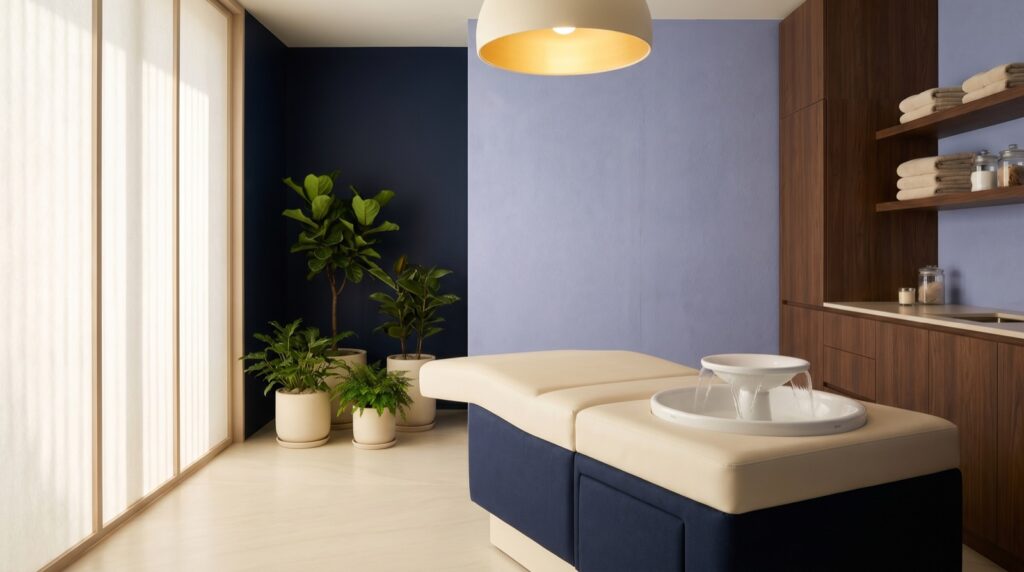
This is a representative case study. To protect client confidentiality, the scenario below is an illustrative composite built from current industry benchmarks rather than a single named client. The figures are real market ranges; the story is a model of how a head spa opening typically comes together.
A successful salon on a busy retail strip has a problem most owners would envy: it is fully booked, and growth has flattened because there are no more hours in the day. The owner has seen the head-spa trend and wants in — but is wary of pouring capital into an unproven room. This is the situation we modeled, and it mirrors what operators across the U.S. face right now.
The challenge
The numbers that keep owners up at night are real. Across the industry, new-client retention averages only about 35%, and typical treatment rooms run at just 35–40% utilization. A head-spa room built without a plan to fill it — and to bring clients back — underperforms quickly. The owner’s three questions were the right ones: How much capital? How do we price it? How fast does it pay back?
The approach: a turnkey room
The model we built keeps the first step deliberately lean, then invests in the things that drive utilization:
- Equipment. A single plumbed Korean-style head-spa bed with integrated LED and steam — a capital item in the $1,350–$1,800 range — paired with a scalp-analysis camera to anchor the consultation.
- Build-out. A minor remodel of existing leased space rather than a ground-up build, in the $10,000–$50,000 range, keeping the room inside an existing footprint.
- Staff. Up-skilling existing licensed technicians through a short head-spa certification — typically $300–$1,200 per technician — layered on top of their state license, not replacing it.
- Menu and pricing. A core service priced into the documented $75–$120 standard tier, with high-margin add-ons (LED scalp therapy $15–$35, masks $20–$45) and a membership tier around $65–$149 per month to build recurring revenue.
The illustrative outcome
Rather than invent a single revenue figure, the model targets the benchmarks that define a healthy room. The goal is to move room utilization from the 35–40% baseline toward the 75–85% best-practice band, and to lift rebooking toward the 75–85% repeat-client benchmark that strong operators achieve — driven by a service that is both relaxing and visibly diagnostic, which is exactly what brings clients back on a monthly cadence.
On revenue, the honest frame is a range, not a promise. Industry data puts revenue per treatment room in the $200,000–$400,000 per year band for well-run rooms, and a single point of utilization improvement is worth tens of thousands annually in an average-size spa. The category tailwind helps: U.S. scalp-care demand grew around 6% in 2025, and the global scalp-care market is projected to expand at roughly 7% a year.
Why turnkey matters
The lesson in the model is that the equipment was never the hard part. The room succeeds or fails on protocol design, staff competency, product sourcing, and a pricing-and-membership structure that drives the utilization curve upward. Those are the elements an owner stretched thin cannot easily assemble alone — and exactly where a turnkey partner earns its keep.
How Luxmetics works on openings
We open head spas turnkey: concept and interior, the right Korean equipment, treatment protocols, staff certification, and the scalp-care product line to retail at the chair. We hold the timeline and the details through grand opening, then stay on to restock and retrain. If you are weighing a head-spa room, we can model your specific numbers against these benchmarks before you commit a dollar.
Planning an opening like this one? Luxmetics opens turnkey head spas with our partner WSD, from design and room layout to sourcing, staff training, and launch. See how our head spa openings work.