
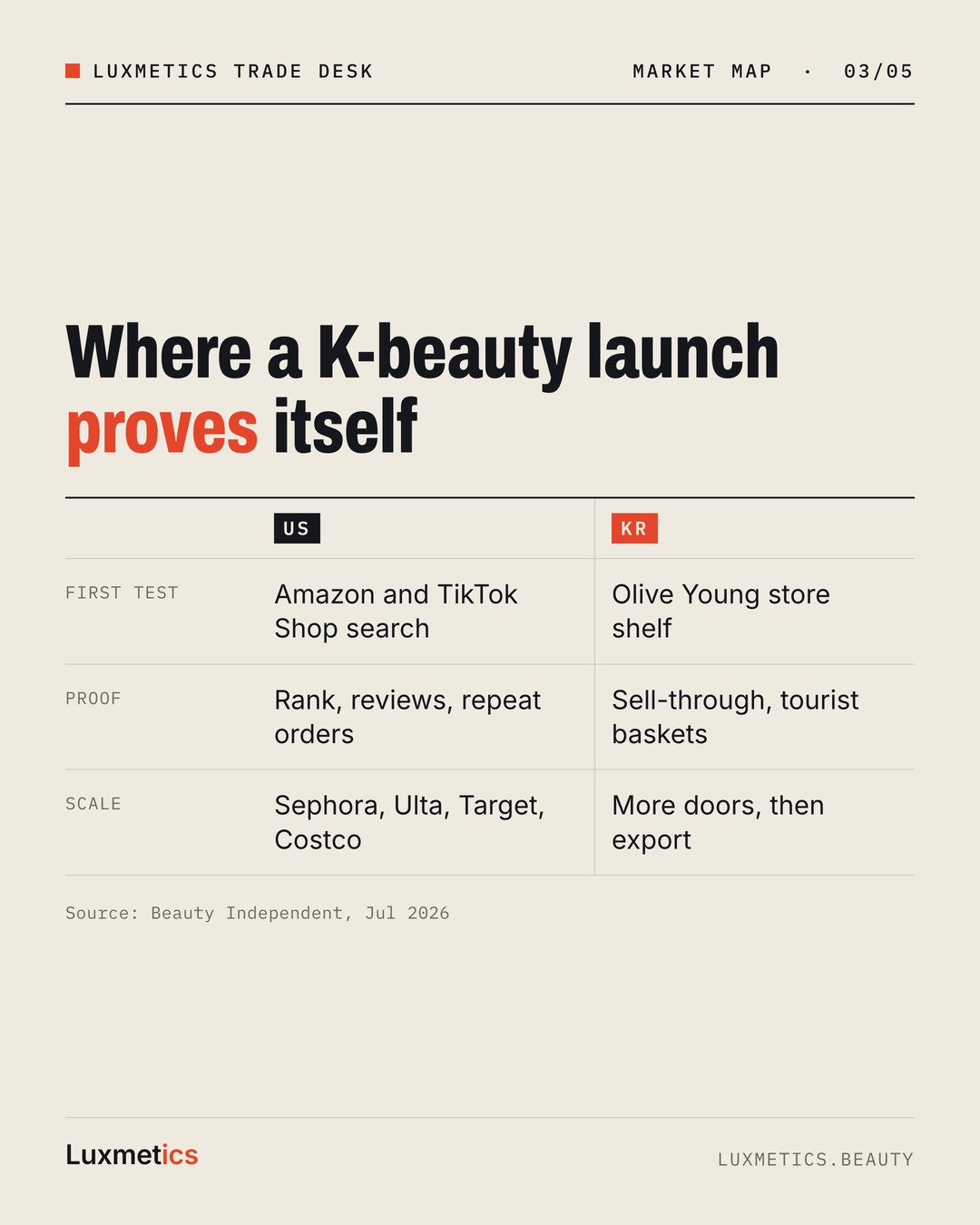
Seoul tests a new beauty brand on a store shelf. The United States tests it in a search bar. A brand that wants both markets usually has to win twice, in two different ways, and the spa owner in the middle sees only the second win: a client who walks in already knowing the name.
This piece maps where a K-beauty brand proves itself first in each country, and what that means for the products you choose, how you talk about them, and what your team adds that a screen cannot.
Korea: the shelf is the first test
In Korea, the proving ground is a store. CJ Olive Young’s 2025 standalone revenue was KRW5.83 trillion, about $4.2 billion and up 21.8%, with net profit of KRW554.7 billion, according to the Seoul Economic Daily. The chain runs more than 1,380 Korean stores. An older summary put its share of the Korean health and beauty store market above 71%, though that share figure dates from 2023.
The number that matters most for a US buyer is a different one. Foreign shoppers made up 28% of Olive Young’s offline sales in 2025, up from 2% in 2022. A brand that sells through on those shelves has been picked up, compared and bought by locals and by tourists from many countries, in person, with testers in hand. That is a physical test, and it is hard to fake.
Olive Young has also started to export its judgment. Since August 20, 2026, Sephora has carried an Olive Young curated K-beauty edit of 19 brands in more than 500 US stores and online. The Korean shelf now travels as a recommendation.
The US: the search bar is the first test
In the US, most Korean brands meet their first American customers on a screen. TikTok Shop US beauty sales reached $980 million in Q2 2026, up 82% year over year, and the top two beauty brands on the platform were Korean: Medicube at $62.8 million and Dr. Melaxin at $38.8 million, according to Beauty Independent, citing Charm.io data.
Amazon tells the same story from the search side. During Prime Day, June 23–26, 2026, Medicube was the number one beauty brand for the second Prime Day in a row with 13.23% share, and K-beauty took 10.5% of all beauty searches, up from 6.5%, according to a Market Defense report. That is vendor data, so read it as a strong signal, not an audited share. Amazon also took more than 40% of US online beauty sales during Cyber Week 2025, per WWD.
The wider market points the same way. Circana found e-commerce was nearly half of US prestige skincare dollars in Q1 2026. In the US, the search result is the first shelf.
Two kinds of proof
The two routes produce different evidence. A Korean store tells you that people chose the product next to its competitors, often after trying it. A US search ranking tells you that people found it, clicked and bought, often after a video. Both matter. Neither tells you how a product performs in a treatment room, under your lighting, on your clients’ skin, with your team explaining it. That part is still yours.
What it means for your spa
If most of your clients meet Korean brands online first, the consultation changes. A few practical moves follow from the map above.
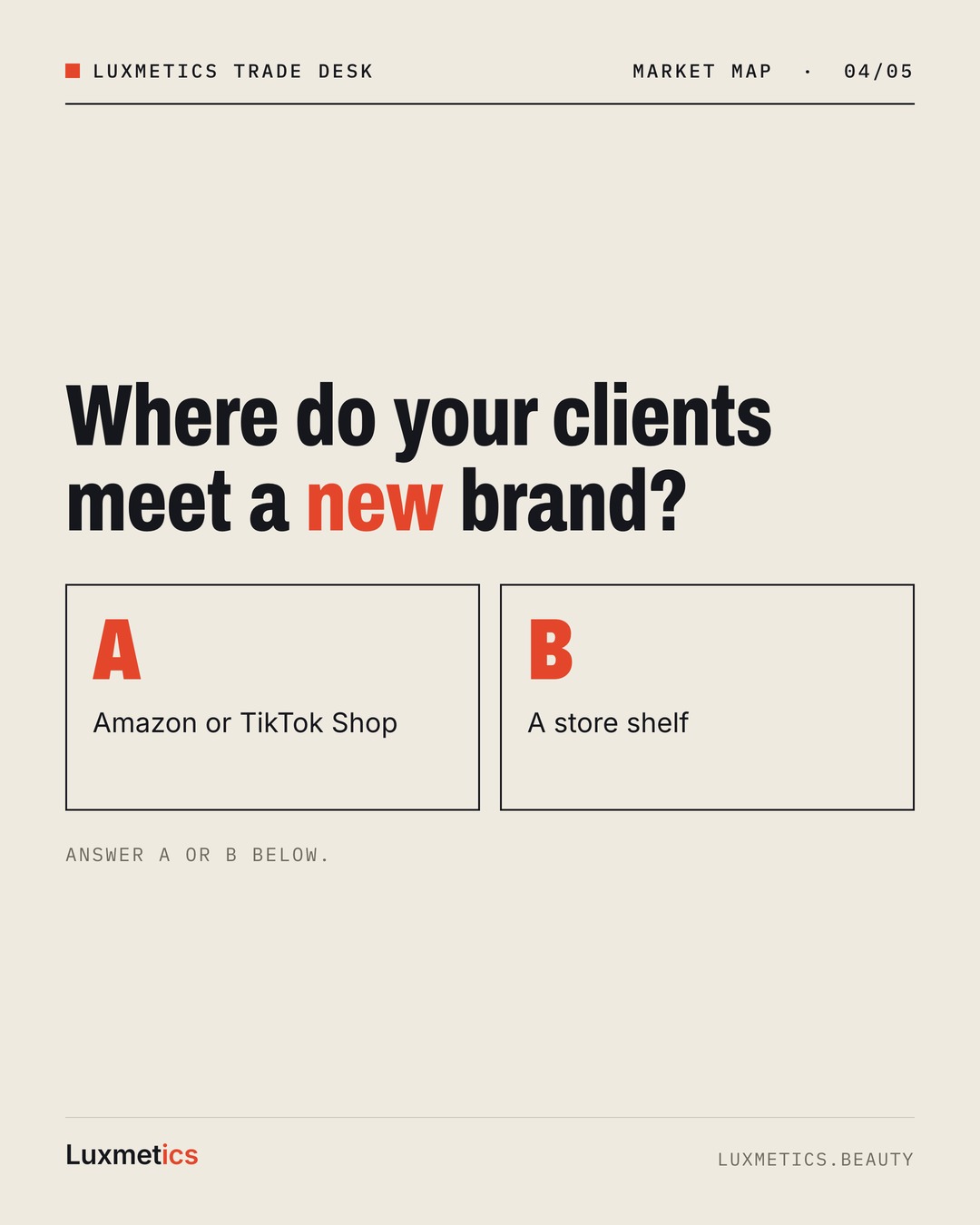
- Ask where they saw it. A client who found a cream on TikTok Shop has seen a demonstration. A client who bought it at Olive Young in Seoul has touched it. Each needs a different conversation.
- Check both kinds of proof before you buy. A brand that is strong in Korean stores and in US search has passed two tests. A brand with search buzz only may still be early.
- Price with the screen in mind. Your client can check the online price in seconds. Your value is the protocol, the fit to their skin and the follow-up.
- Use the treatment room as the demo. The one thing neither route offers is a trained professional applying the product. Build services that show it, then sell the take-home.
The brands that win in both countries tend to be the ones clients ask about by name. Your shelf does not need to compete with Amazon on price. It needs to be the place where a name the client already knows becomes a routine they trust.
Getting a Korean line onto your US shelf
We watch both sides of this map. In Seoul, we see which brands sell through at the store level and which are already on the way out. In the US, we track which names your clients are searching for. When you want a line, we source it from Korea, consolidate it with the rest of your order, check labels and MoCRA product listings before it ships, and train your team on the protocol, so the brand your client found online arrives with a professional behind it. You choose the lines. We bring the evidence from both markets to the table.