
“What is your MOQ?” is usually the first thing a US buyer says at a Korean booth, and it is rarely the most useful first question. Minimum order quantity matters, but a low MOQ on a product that cannot legally reach your shelf is worth nothing. The buyers who come home from a trade show with workable orders tend to ask about labels and listings first and price second.
K-Beauty Expo Korea 2026 runs from Thursday, October 15, to Saturday, October 17, in Halls 3 to 5 at KINTEX in Goyang, just north of Seoul. KINTEX and KOTRA organize it, according to the official show site. This guide sets out how a US spa owner, clinic manager or retail buyer can get real value from three days on the floor. It makes no claims about which companies will exhibit.
Before the flight
Most of a trade show’s value is decided before you land. Suppliers at a large expo meet many visitors, and a buyer with a booked slot and a clear brief gets a more serious conversation than one who stops by between aisles.
- Write a one-page brief. Who your clients are, your price points, the services you run, and the categories you want to fill. Keep it in English and have a short Korean version ready.
- Book meetings early. Contact suppliers in your target categories two to three weeks out and ask for a fixed time at the booth.
- Plan for October lead times. Chuseok fell on September 24 to 26 this year and closed Busan port on September 25, so expect supplier schedules to run a little behind into early October. Ask each supplier what their current production queue looks like.
- Know your budget per category. A number in your head keeps sample requests realistic.
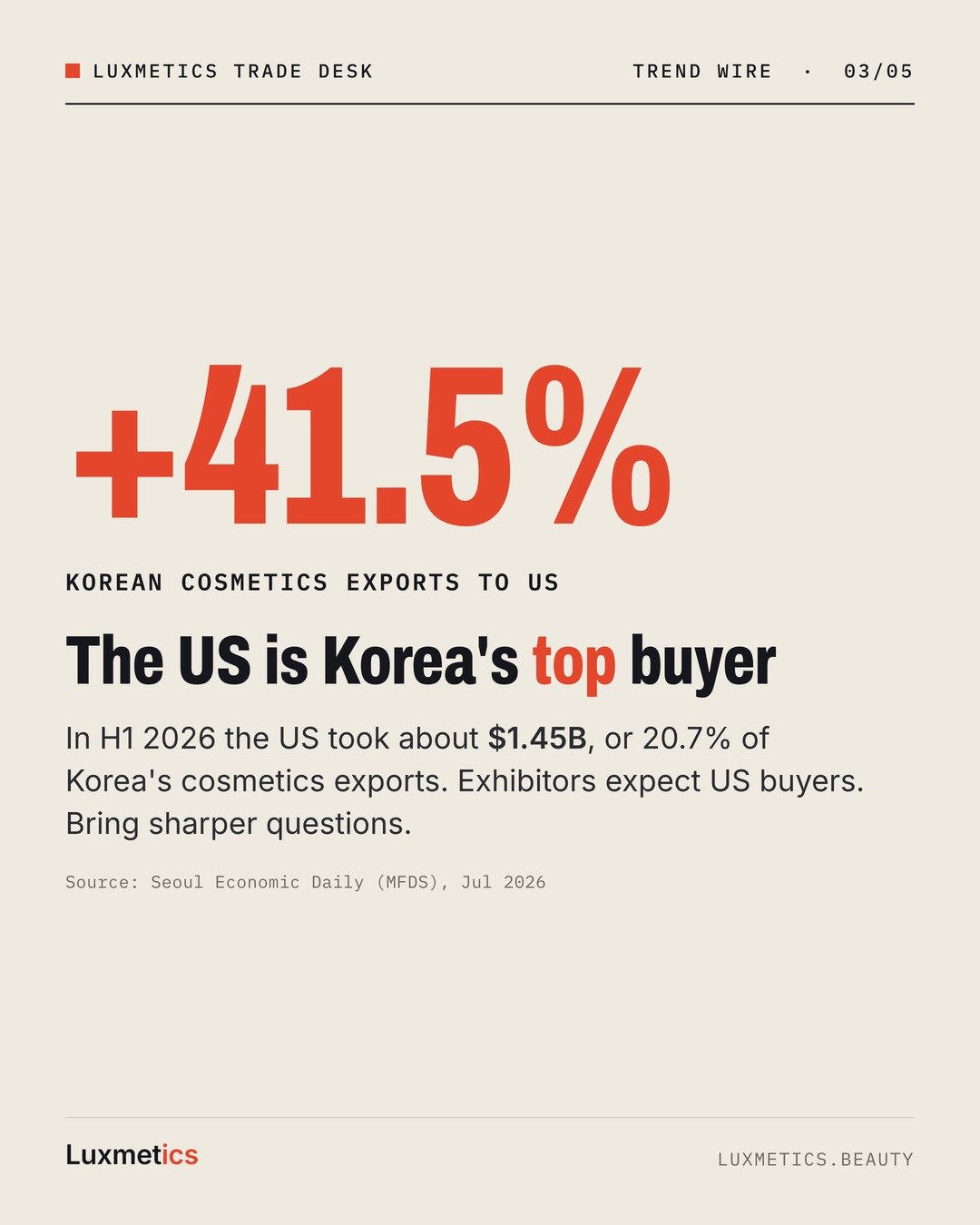
Korean suppliers have reason to take US buyers seriously. The United States was the top destination for Korean cosmetics in the first half of 2026, at about $1.45B, or 20.7% of the total, up 41.5% year on year, according to Seoul Economic Daily, citing Ministry of Food and Drug Safety data. Total exports reached a record $7.0B in the same period.
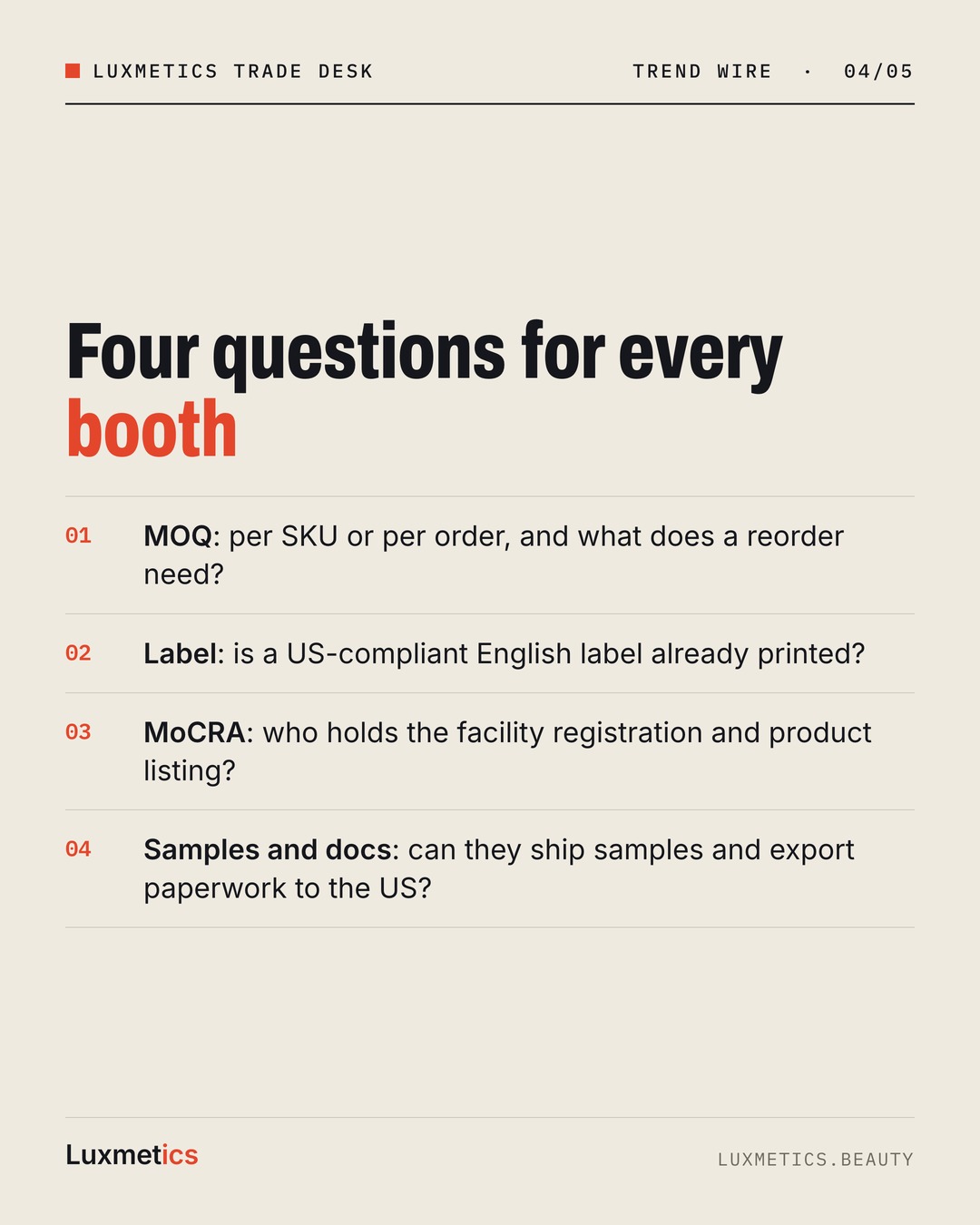
At the booth: four questions in the right order
Keep the same four questions for every supplier so the answers can be compared later.
- Is there a US label? Ask whether an English label built for US rules is already printed, or whether one would have to be designed. A new label adds time and often a separate minimum.
- Who holds the MoCRA registration and listing? Under MoCRA, the facility that makes a cosmetic sold in the US must be registered with FDA, and each product must be listed. As of January 6, 2026, FDA counted 14,299 active facility registrations and 992,907 active product listings, according to Foley & Lardner. Ask for the registration number and who the responsible person is for the US.
- What are the MOQ and reorder terms? Now price and quantity make sense. Ask whether the minimum applies per SKU or per order, and what a reorder requires.
- Samples and export documents. Ask whether they can send samples to the US and what export paperwork they normally prepare.
Write the answers on the supplier’s own brochure before you leave the booth. By the second afternoon, the aisles blur together.
This guide is general information. It is not regulatory or customs advice, so check MoCRA status and product classification with a qualified advisor or licensed customs broker before you order.
After the show
The week after is where orders are won or lost. Send each supplier a short follow-up within a few days, restating what you discussed and what you asked for. Sort your notes into three piles: ready to sample, needs a US label or listing first, and not a fit. Test samples with your own team before any client sees them, in the treatment room and at home.
If the show is not in your travel plans, the same questions work by email and video call. Cosmoprof Asia in Hong Kong follows in November (Cosmopack from November 10 to 12 at AsiaWorld-Expo, Cosmoprof from November 11 to 13 at HKCEC), which gives buyers a second chance to meet suppliers in person before year end.
When quotes arrive, compare them on landed cost instead of unit price. Add freight, duty and any label work to each quote before ranking them. Duty on goods from Korea currently sits under a 12.5% combined ceiling that includes the MFN rate, according to UPI, but the rate for a specific product depends on its classification, which your broker should confirm. A supplier with a slightly higher price and a finished US label can easily come out cheaper.
The buyers who do best at trade shows usually leave with fewer suppliers than they expected. Three suppliers with clean labels, clear listings and honest lead times beat twelve with good prices and open questions.
Your desk on the show floor
Luxmetics works from Seoul and Los Angeles, so we can book meetings at KINTEX in advance, sit in on booth conversations, and follow up in Korean after you fly home. Before anything ships, we check the US label and the MoCRA facility registration and product listing, then consolidate orders from several suppliers into one shipment. Your team decides what earns a place on the shelf. We help make sure it can get there.