

Seven billion dollars in six months. That is what Korea exported in cosmetics in the first half of 2026, a record, and the US bought more of it than any other country. We covered the first headline back in July. Three months on, the September data is in, and the story has moved from “the US passed China” to a question closer to your stockroom: what happens to supply when everyone wants the same Korean skincare at once?
The numbers, in one place
According to Seoul Economic Daily, reporting Ministry of Food and Drug Safety data, Korea’s cosmetics exports reached a record $7.0 billion in H1 2026, up 27.3% year over year. Q1 was $3.1 billion and Q2 was $3.9 billion, so the pace picked up as the year went on.
The US was the number one destination at about $1.45 billion, or 20.7% of the total, up 41.5%. China came second at $1.01 billion, down 6.6%, and Japan third at $580 million, up 5.9%.
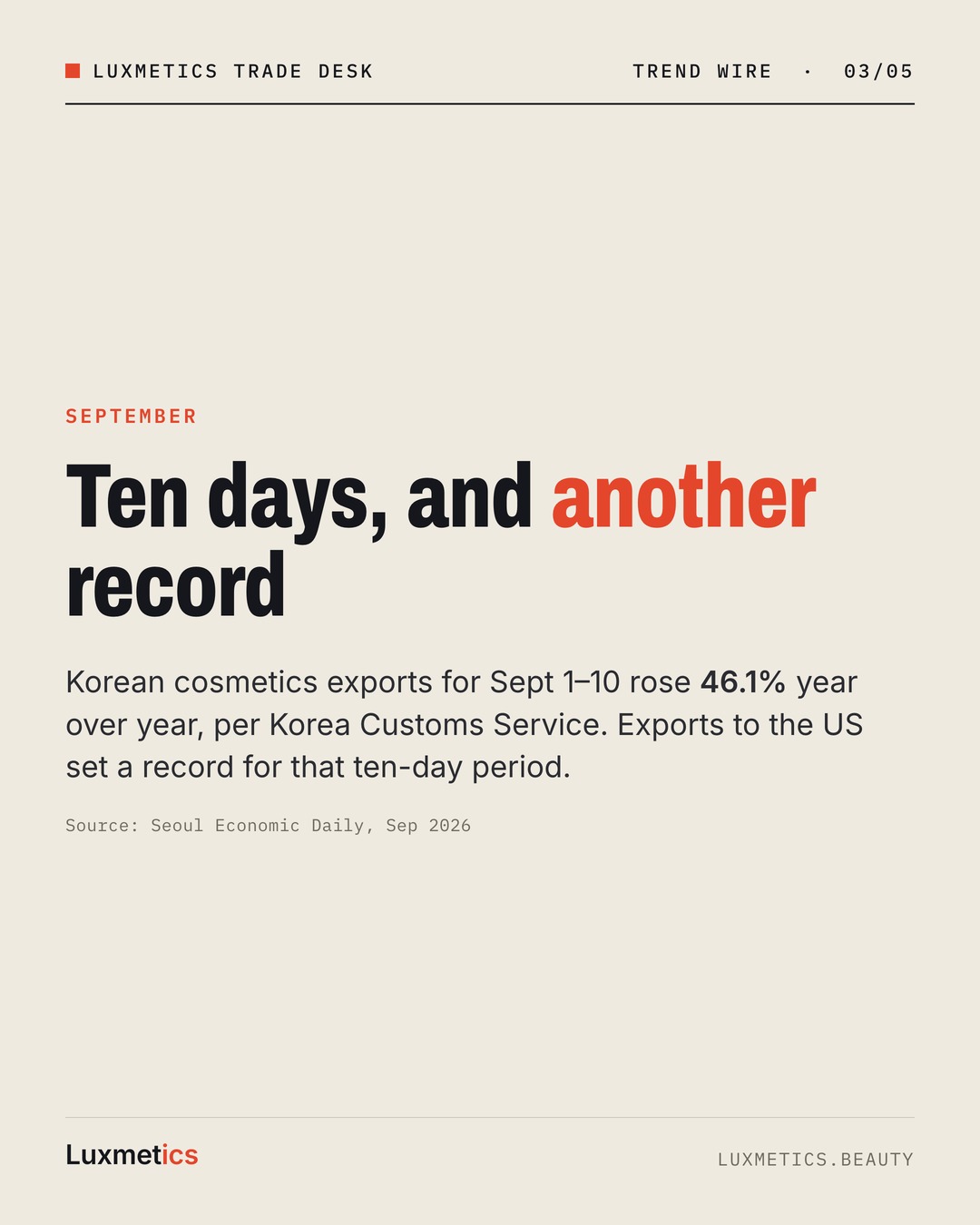
The pace has not slowed since. For September 1–10, Korean cosmetics exports rose 46.1% year over year, based on Korea Customs Service data, and exports to the US hit a record for that ten-day period, as Seoul Economic Daily reported on September 15. There is no clean monthly total for August yet, so we are leaving that gap open rather than guessing.
For scale: Korea was already the world’s number two cosmetics exporter in 2025 with $11.4 billion, passing the US at $10.8 billion, per Korea Biomedical Review. France remains first. The first half of 2026 puts Korea on a faster track than that record year.
Skincare carries the boom
The category split is where a spa buyer should spend the most time. In H1 2026, basic skincare exports were $5.48 billion, up 25.0%. Color cosmetics were $720 million, down 4.2%. Body cleansing was $340 million, down 20.6%.
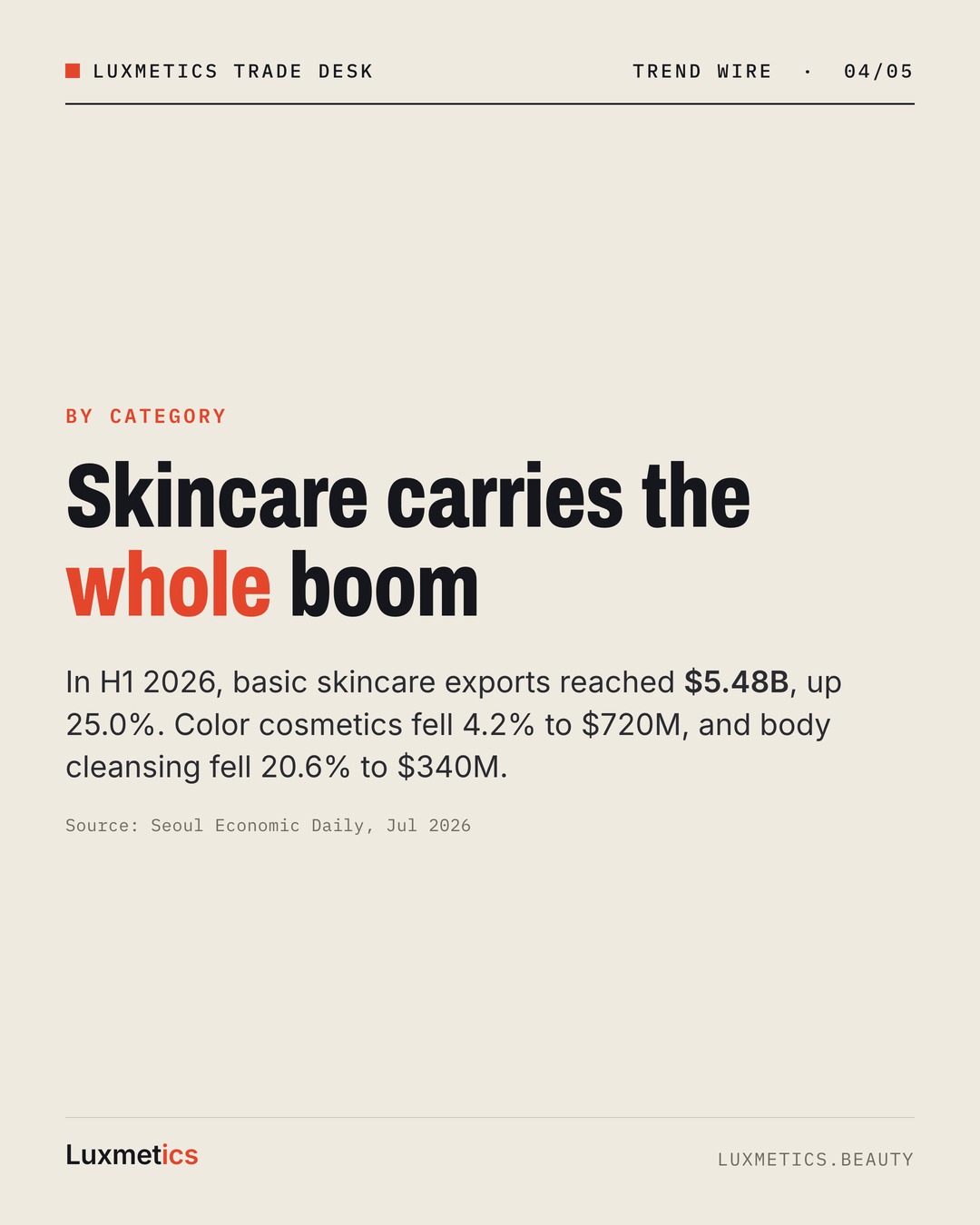
So nearly four of every five export dollars were skincare, and skincare is the only one of the three big categories that grew. That is good news for professional buyers, because skincare is what a spa uses and sells: cleansers, toners, ampoules, masks, creams. It also means the growth is concentrated. The same categories you rely on for the back bar and the retail wall are the ones every other importer is ordering.
What a skincare-led boom looks like from the buying side
Nothing in the export data measures lead times or minimum order quantities directly. But the direction is easy to read. When exports to one country rise 41.5% in six months, Korean brands and their factories are filling more US orders than a year ago, and the September figures suggest the demand is still rising. In practice, buyers tend to see this in three places:
- Quotes that take longer to come back, because brand teams are answering more US inquiries.
- Best sellers that go on allocation, while slower lines stay easy to get.
- Tighter attention to paperwork, since a US order now needs labels and a product listing that match what is in the carton.
Treat those as patterns to watch, not measured facts. The useful response is the same either way: order the hero skincare earlier, and keep a second option in each category.
Three questions for your next Korea order
Before you place an autumn or winter order, work through these with your team or your sourcing partner.
- Which of our Korean SKUs are skincare best sellers that everyone else wants too? Those need the earliest order dates and a backup product that fits the same service.
- Are we leaning on color or body products that the export data shows shrinking? Falling exports do not mean those products are bad. They may mean fewer new launches and less choice in the next year, so check that your supplier is still committed to the line.
- How much of our retail wall is Korean, and is it the right mix? If Korean skincare is what your clients ask for, the wall should say so. If it is a side shelf, the growth numbers are a reason to test a larger bay.
One caution on reading export statistics. They measure what left Korea, in dollars, at export value. They do not measure retail sales in the US, and they include products headed to Amazon warehouses, big-box chains and online sellers as well as the professional channel. The trend is clear. The share that reaches spas and clinics is not broken out.
Turning export numbers into a buying plan
When a category runs this hot, access matters as much as price. Our Seoul team talks with Korean brands directly, so we can tell you early which skincare lines are tight and which have room. We consolidate your picks from several brands into one shipment, check that labels and MoCRA listings match the product before it leaves Korea, and train your team on the protocols behind the products you bring in. You decide what goes on your wall. We make sure it arrives, and that your staff can explain it.