
Korean hair care crossed a line this year that most U.S. buyers have not registered yet. For five years the category was sold to Americans as a scalp story: cleanse the scalp, exfoliate the scalp, treat the scalp like skin. That framing worked, and it built the shelf. It is now the smaller half of what is actually shipping. The growth has moved past hygiene into density, thinning and treatment, and the operators who understand exactly where the U.S. regulatory line falls will be the only ones able to sell that tier here without inviting trouble.
The numbers moved before the narrative did
Korean hair care shipments reached USD 478 million in 2025, up 15.7 percent on the previous year, according to Korean trade figures reported in March 2026. The first five months of 2026 brought in USD 232.62 million, a 30.6 percent jump against USD 178.15 million in the same window of 2025, and Korean industry projections published in June 2026 have the full year clearing USD 500 million for the first time.
That sits inside a larger shift already familiar to anyone importing from Korea. The Ministry of Food and Drug Safety reported record cosmetics exports of USD 11.43 billion in 2025, with the United States displacing China as the top destination. Hair is not the biggest line in that total. It is the one accelerating fastest, and it is accelerating into a U.S. market that was already primed by three years of scalp-care education.
Where Korean hair care goes after the scalp
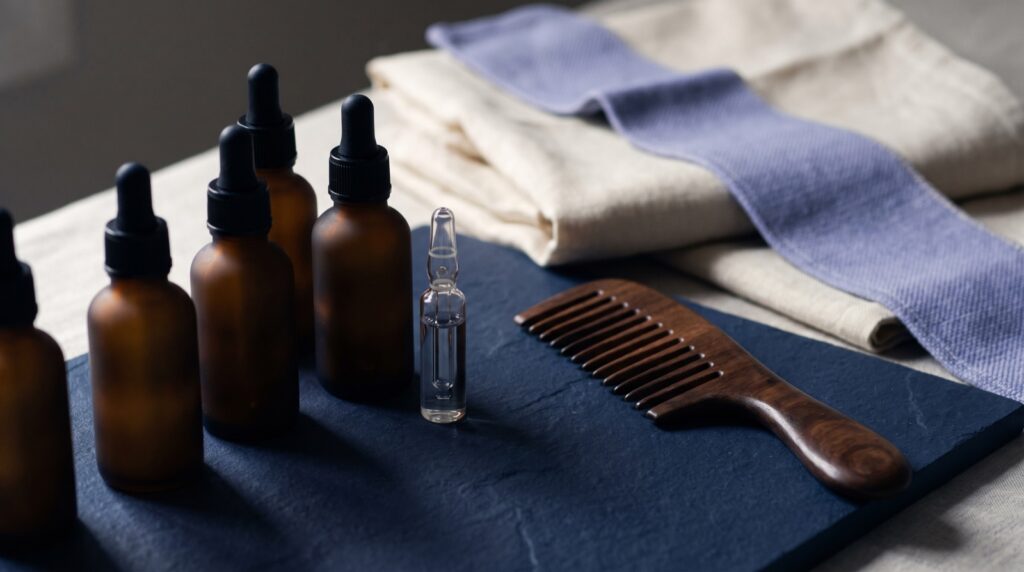
The first wave was cleansing architecture: scalp scalers, clarifying shampoos, exfoliating tonics, cooling ampoules. Useful products, low ticket, high repeat. The second wave is a different economic animal. It is root serums, density ampoules, single-dose vials, bonding and repair treatments, and in-salon protocols that sit somewhere between a facial and a hair service.
The demand signal underneath it is real rather than trend-driven. The global functional hair-loss care market is projected to grow from USD 2.9 billion in 2026 to USD 4.3 billion by 2030. Botanical actives are the fastest-moving entry point: the rosemary oil hair-growth segment was valued at USD 0.62 billion in 2025 and is forecast to reach USD 1.25 billion by 2034, an 8.0 percent CAGR. Korean formulators are unusually well positioned here, because the ingredient-substantiation habits that made K-skincare credible transfer directly to a category where American consumers have been burned repeatedly by claims that went nowhere.
The shelf is already built
Distribution has stopped being speculative. Over the past year LG Household & Health Care put Dr. Groot into all 680 Costco stores in North America and into Sephora U.S. doors. Aekyung placed Kerasys in roughly 390 Walmart locations in March 2026. Amorepacific’s Mise-en-scène Perfect Serum ranked first in the hair oil category during Amazon’s Big Spring Sale, and Aromatica’s Rosemary Root Enhancer has been a top seller in Amazon’s scalp treatment category in both the U.S. and Europe.
Read that list carefully and the opportunity inverts. Mass retail hair care from Korea is no longer an opening; it is a crowded lane with three conglomerates already in it. The room that is still open is the professional and treatment tier: the ampoule, the in-clinic protocol, the back-bar line a head-spa or salon uses and then sells at the chair. That tier is where margin lives, and it is the tier the big three are not optimized to serve.
The regulatory line that catches importers
This is the part that costs people money, and it is entirely avoidable.
Korea has a regulatory category the United States does not. Under MFDS rules, “functional cosmetics” include products approved for relieving hair-loss symptoms. A Korean brand can hold that approval, put it on the Korean label, and build a whole marketing deck around it, legally.
The FDA has no equivalent. Under U.S. law, intended use determines classification, and the agency states plainly that claims a product will restore hair growth are drug claims, regardless of how the product is otherwise marketed. There is no cosmetic pathway for that claim. A Korean product that is entirely compliant at home becomes a misbranded, unapproved new drug the moment its Korean claim set is translated onto a U.S. label or a U.S. product detail page.
The practical rule is short: the Korean marketing deck is not a U.S. label, and translation is not compliance. Appearance of fullness, look of thicker hair, reduced breakage, scalp comfort and scalp condition all survive the crossing. Regrows hair, prevents hair loss, treats alopecia, and stimulates follicles do not. Neither does a before-and-after image that makes the drug claim visually while the copy stays careful.
MoCRA sits on top of all of this. Facility registration, product listing, a named U.S. responsible person and safety substantiation apply to a hair ampoule exactly as they apply to a serum. A brand that has cleared MoCRA but not scrubbed its claim set is halfway compliant, which in enforcement terms is not compliant.
Why this belongs in the treatment room
U.S. operators who added head spa over the past two years already own the physical asset this category needs: a chair, a bowl, a trained pair of hands and a client who has agreed to sit still for forty minutes. What most of them do not yet have is a treatment-tier product line to sell from it.
The attach economics are the point. A scalp treatment service produces a client who has just spent an hour being told, credibly, that their scalp is skin. Selling that client a four-week ampoule course at the chair is a materially different conversation than selling a shampoo, and it carries a materially different margin. It also requires staff who can explain what the product does and, more importantly, what it does not, which is the same compliance discipline described above expressed as a talk track rather than a label.
The operator’s view
Korean hair care is not an emerging category in the U.S. anymore; it is a maturing one splitting into two very different businesses. The mass tier is spoken for. The professional and treatment tier is open, higher margin, and gated by exactly one thing: whether you can carry Korean efficacy into an American claim environment without importing the Korean claim language along with it. Most of the risk in this category is not formulation risk. It is copy risk.
How Luxmetics fits is narrow. When we source Korean hair and scalp lines for U.S. operators, claim review happens before the purchase order, not after the first marketplace complaint, and we treat the U.S. label and the back-bar talk track as part of the sourcing job rather than the buyer’s problem afterwards. A hair ampoule that cannot be legally described is not a product. It is inventory.