
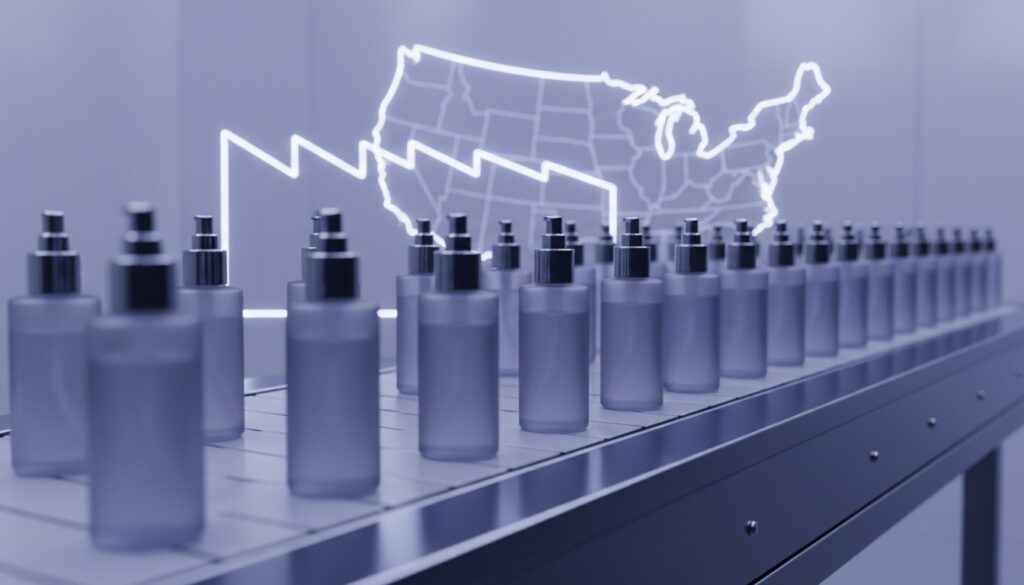
Two weeks ago we wrote that tariffs and the end of de minimis had rewritten the landed-cost math for Korean beauty. The Korean manufacturing giants read the same math, and they are responding in the most consequential way possible: building capacity inside the United States. The largest Korean ODMs are no longer just exporters shipping finished goods across the Pacific. They are becoming U.S. manufacturers. For an importer, this is one of the most important structural shifts of the year, because it changes where “made in Korea” ends and what a Korean sourcing program can even mean.
What is actually being built
The clearest signal comes from Kolmar Korea, one of the two dominant Korean contract manufacturers. Its second U.S. plant, in Pennsylvania, is scheduled to reach full operation in the second half of 2026, and the scale is serious:
- The new facility lifts Kolmar’s U.S. sun-care capacity from 180 million to 300 million units, and brings its total North American capacity to around 470 million units, described as the largest of any cosmetics ODM on the continent.
- The plant holds U.S. FDA OTC certification for sunscreen manufacturing, which matters enormously given that sunscreen is a drug in the U.S. and OTC-compliant domestic capacity is scarce.
- Kolmar is explicit that the U.S. base is a “tariff safe zone”, built specifically to let Korean and global brands sidestep the trade barriers reshaping import economics.
Cosmax, the other giant, sits at the top of the global ODM industry by revenue and is expanding regional capacity of its own. The direction across both leaders is the same: put manufacturing closer to the market it serves.
Why the giants are moving production
This is a rational response to exactly the cost pressures we have been documenting. When tariffs and the loss of the de minimis exemption raise the landed cost of a finished import, the counter-move is to manufacture inside the tariff wall. A Korean ODM that can offer a brand U.S.-made product, with Korean formulation expertise and FDA OTC sunscreen capability, removes the single biggest variable that had been eroding importer margins. It is the manufacturing base voting with capital on where U.S. beauty demand is heading and how to serve it without paying the import tax.
The operator’s caution: “K-beauty” and “imported from Korea” are separating
Here is the strategic wrinkle an importer has to absorb. For years, sourcing Korean beauty and importing from Korea were the same decision. They are now becoming two different decisions. A product can be formulated with Korean expertise, carry the K-beauty positioning consumers want, and be manufactured in Pennsylvania, never crossing a border as a finished good. That is a genuine advantage on landed cost and lead time, and for sunscreen it may be the cleaner compliance path. But it is not automatically the right answer for every product. Domestic ODM runs typically carry different minimums and cost structures than importing an existing Korean SKU, the “made in Korea” story has marketing value that “made in USA by a Korean ODM” does not, and not every formula or category has U.S. capacity yet. The sourcing decision is now a real choice between importing the finished Korean product and commissioning U.S.-made production from a Korean manufacturer, and the right call depends on the category, the volume, and how much the origin story matters to the buyer.
What this means for sourcing
- Add U.S.-made Korean production to the option set. For tariff-exposed, high-volume, or sunscreen products, domestic ODM capacity from a Korean manufacturer can beat importing on both cost and compliance. It belongs in the sourcing comparison now.
- Sunscreen is the standout case. FDA OTC-certified U.S. capacity for K-SPF-style formulas is rare and newly available. If sun care is in your assortment, this changes the math most.
- Weigh the origin story deliberately. “Made in Korea” carries marketing weight with the K-beauty consumer. Decide whether the landed-cost saving of U.S. production is worth trading that narrative, category by category.
- Check what capacity actually exists. The build-out is real but not universal. Confirm the specific formula and category can be made at the U.S. facility before assuming domestic production is an option.
The operator’s view
The Korean ODM giants building U.S. capacity is the supply-side answer to the tariff story, and it quietly splits a decision that used to be one. Sourcing Korean beauty and importing from Korea are no longer the same thing. That is an opportunity, especially for sunscreen and tariff-exposed volume, but it is also a more complex choice than “find a Korean supplier.” The winners will treat U.S.-made Korean production as one tool among several, matched to the product rather than applied by default.
How Luxmetics fits is narrow and practical: we work the Korean manufacturing base as it extends into the U.S., help weigh imported-from-Korea against U.S.-made Korean production for each category, and keep the landed-cost, compliance, and origin-story trade-offs explicit so the choice is deliberate. The manufacturing map is being redrawn. Reading it correctly is the sourcing advantage.