
Update: On August 20, 2026, 19 Olive Young-curated brands landed in 500+ Sephora stores. Here is what that changes for operators.
When Olive Young opened its first US store in Pasadena on May 29, 2026, shoppers lined up around the block and some camped overnight. For a Korean health-and-beauty chain making its physical American debut, that scene says something important: K-beauty in the United States is no longer an online curiosity. Korea’s largest beauty retailer has arrived in person — and for any brand or operator sourcing from Korea, that changes the playing field.
What’s actually happening
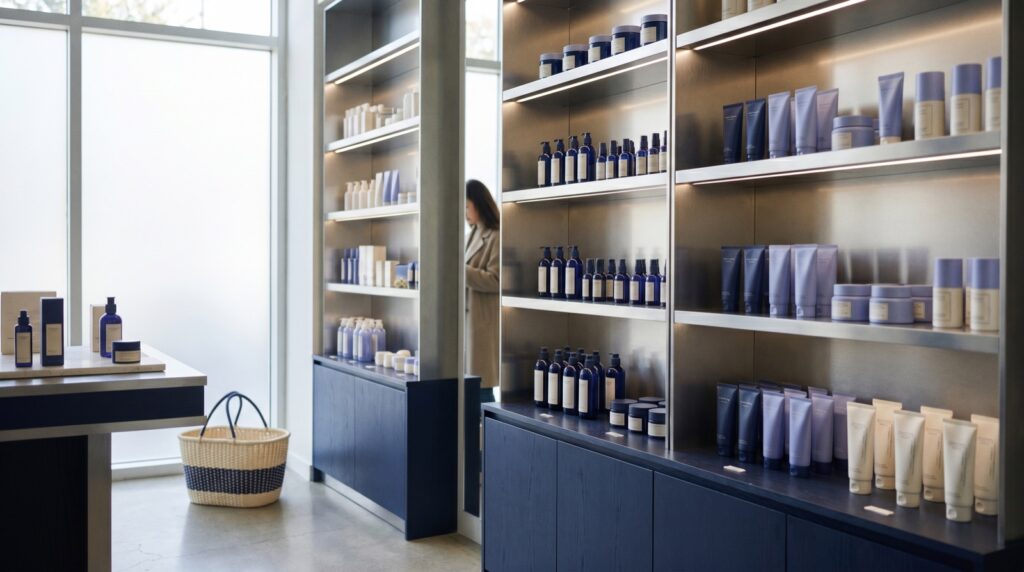
Olive Young’s US move has been building deliberately. CJ Olive Young established its US subsidiary in February 2025, then opened the Pasadena flagship 15 months later with roughly 400 brands and 5,000 SKUs across skincare, makeup, hair, wellness, and inner beauty. A second store at LA’s Westfield Century City is slated for June 2026, anchoring a broader California rollout.
This is not a small experiment. In Korea, Olive Young runs more than 1,380 stores and posted 2024 revenue of ₩5.83 trillion (about $4.2 billion), up 21.8% year over year. The retailer has spent years building global demand before planting a US flag.
The US was already its biggest online market
Here is the detail that should reframe how operators think about this. Olive Young Global, its cross-border e-commerce platform, now ships to roughly 150 countries — and in the first half of 2025, US customers generated more than 50% of the platform’s sales and over 40% of its total sales growth. The physical store isn’t testing US demand; it’s amplifying demand that already exists.
The wider numbers confirm it. Olive Young drew 9.42 million foreign-customer transactions from 189 countries in 2024, with foreign sales up 140% year over year. Platform sales in H1 2025 rose 70%, with the UK up 300% and Japan up 180%. The US sits at the center of that map.
The K-beauty retail shift around it
Olive Young is landing into a market that has already tilted toward Korea. US K-beauty sales were projected to exceed $2 billion in 2025, up about 37% year over year (NielsenIQ). Ulta has reported Korean skincare as its fastest-growing beauty segment, up 38%, and Circana’s prestige data showed K-beauty growing 23% in dollars in early 2026. K-beauty isn’t just available in the US — it’s outpacing the categories around it.
Olive Young’s own positioning is worth noting: the Pasadena store is framed as a “beauty playground,” mixing Korean and Western brands rather than a Korea-only shop. That signals ambition to become a mainstream US beauty destination, not a niche import.
What it means for brands and operators
Olive Young’s arrival is double-edged, and both edges matter:
- It’s a new gatekeeper. With 400 brand slots in a flagship and a curated platform, being selected — or not — shapes a brand’s US visibility. The brands inside that assortment gain a powerful shop window; those outside compete against it.
- It validates the whole category. A retailer of this scale committing to US physical retail is proof that K-beauty demand is structural, not a passing social-media spike. That de-risks investment in US-ready supply for everyone.
- It raises the compliance bar. US retail means MoCRA registration, and US OTC sunscreen rules that restrict some Korean UV filters. Brands not built for US requirements can’t ride this wave, however strong the demand.
The operator’s view
Olive Young’s US entry is the clearest signal yet that Korean beauty has crossed into the American mainstream — and that the bottleneck is no longer demand, but being US-ready when the demand arrives. At Luxmetics, we help Korean brands and US operators on exactly that gap: sourcing and vetting the right brands, handling MoCRA and import compliance, and building the distribution that gets product onto US shelves — Olive Young’s or your own. If this shift is on your radar, the time to be ready is before the next store opens, not after.