
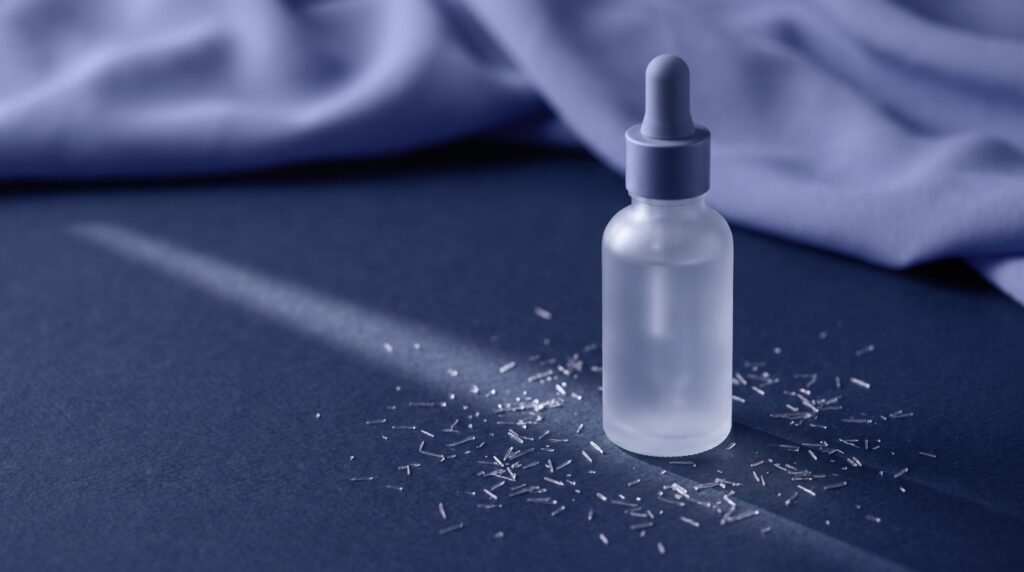
For a decade, the K-beauty conversation was about what was in the bottle — retinal, PDRN, peptides, exosomes, the ingredient of the season. In 2026 the conversation is quietly moving one layer down the stack: not what is in the serum, but how it actually gets into the skin. The clearest signal of that shift is spicules — microscopic silica needles that turn an ordinary serum into something much closer to an at-home microneedling device. For anyone sourcing K-beauty into the US, this is the trend to understand before your competitors’ shelves fill with “needle shot” and “reedle” SKUs.
What a spicule actually is
A spicule — or microspicule — is a microscopic, needle-shaped structure of highly purified silica, harvested from the mineral skeleton of freshwater or marine sponge. Each one is far too small to see, and a single product contains many thousands of them suspended in a serum or cream. When the product is massaged in, those needles create temporary micro-channels in the skin’s outer layer, which is why the category has picked up the nickname “liquid microneedling.” The point is delivery: instead of waiting hours for an active to diffuse through the skin barrier — if it gets through at all — spicules open physical pathways on contact. Formulators cite absorption gains on the order of 70-plus times versus simple topical application. That is not a marketing rounding error; it is a different mechanism.
Why it is breaking out now
Spicules are not new. Korean labs have worked with them for more than ten years. What changed is that global demand finally caught up to the technology. Breakout products — VT Cosmetics’ Reedle Shot and Medicube’s needle- and exosome-based “shots” among them — pushed the format into Western routines, and cumulative unit sales across the category have run past 11.7 million units, enough that Korea now treats some of these products as a distinct class closer to a topical device than a cosmetic. Trend forecasters are framing 2026 as the start of the “delivery technology” era, where the story is no longer a hero ingredient but the system that carries it — spicules and exosomes increasingly formulated together, the needle opening the door and the payload walking through it.
The operator’s caution: this is where cosmetic meets device
The commercial upside is obvious. A spicule product feels like it works instantly — the tingle, the flush, the smoother finish an hour later — and that sensory proof drives repeat purchase in a way most serums never manage. But the same feature that sells it is the feature that raises a regulatory flag. A product engineered to physically breach the skin barrier does not sit comfortably in the cosmetic lane, where products are legally defined by cleansing and beautifying, not by penetrating tissue. Push the marketing toward “microneedling,” “penetrates the dermis,” or any structural claim and a US regulator can reasonably start asking whether the thing is still a cosmetic at all. The purity grade of the silica, sensitization and irritation testing, and batch-level documentation all move from nice-to-have to load-bearing.
What this means for sourcing
- Vet the spicule, not just the serum. The needle is the product. Silica grade, particle geometry, and consistency between batches determine both efficacy and safety, and they vary widely across manufacturers.
- Buy the paperwork. Irritation and sensitization data, purity specifications, and claim substantiation are what make a spicule SKU defensible on a US shelf. Sourcing the bottle is easy; sourcing the file behind it is the actual work.
- Keep the claim in the cosmetic lane. Market the outcome — smoother texture, brighter, more “polished” skin — not the mechanism. The moment the copy sounds like a medical device, the compliance burden becomes one.
- Watch the pairings. Spicule-plus-exosome and spicule-plus-peptide combinations are the next wave. They also stack the sourcing and claims questions, so qualify the whole formula, not just the buzzword on the front.
The operator’s view
Spicules are a real technology shift, not a texture gimmick. The absorption problem they solve — actives that never actually reach the skin they are sold to treat — is genuine, and the format is not going away. But the winners in the US will not be whoever imports the most viral “needle shot” fastest. They will be the operators who understand that a spicule product lives on the seam between cosmetic and device, and who source the grade, the testing, and the claim language that keep it on the right side of that line.
How Luxmetics fits is narrow and practical: we work the Korean manufacturing base where these delivery systems originate, qualify the spicule grade and safety documentation before you commit inventory, and pressure-test claim language against US rules so a breakout format does not become a breakout liability. The technology is worth importing. The homework is what makes it a business.