
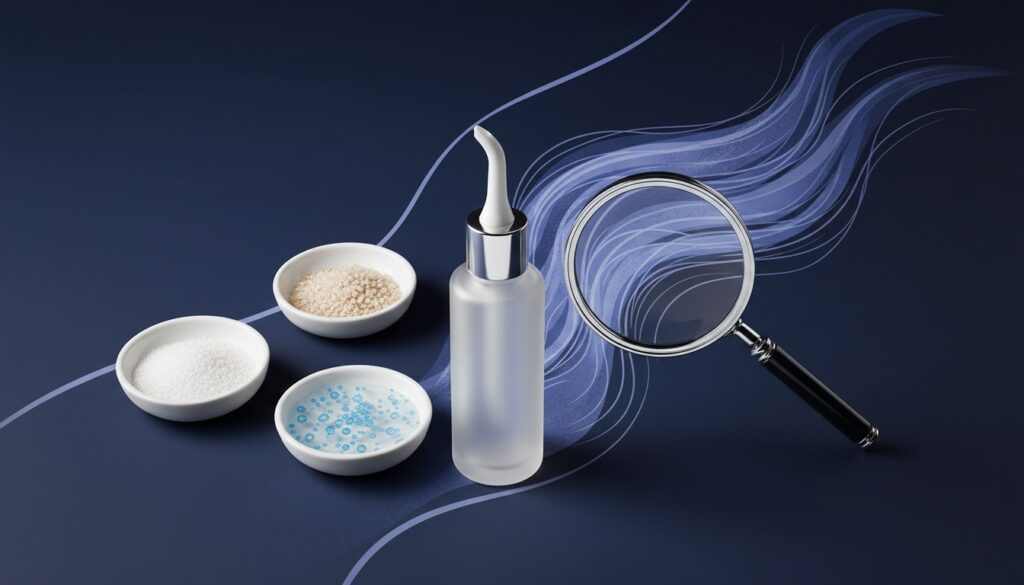
Last week we argued that K-beauty is moving from a single hero ingredient toward the whole skin ecosystem. There is a second front in that same shift, and it is growing faster than the face: the scalp. Scalp care has become the fastest-growing sub-category in hair, driven by a simple reframe that the scalp is skin. For a U.S. importer, this is a category where Korean manufacturing has a genuine head start and where the professional channel and the retail shelf are opening at the same time.
What the “scalp is skin” shift actually is
The idea behind the trend is that the scalp behaves like facial skin, so it deserves the same rigor: exfoliation, barrier support, and microbiome balance instead of just cleansing. The industry calls it the skinification of hair care, and it has pulled facial actives straight onto the head. Salicylic and other mild acids for exfoliation, niacinamide and ceramides for barrier support, peptides and caffeine for follicle stimulation, and pre- and postbiotics to balance sebum and calm irritation. The scalp microbiome, the community of organisms living at the root, is now treated as something a product should support rather than strip.
Korea did not invent scalp care, but Korean haircare philosophy has long centered on scalp nutrition, layered treatment routines, and long-term follicular health rather than surface shine. That is exactly the science-forward, routine-driven approach the trend now demands, and Korean lines like Dr.G Scalp, Pyunkang Yul, Aromatica, and Anua Scalp are already among the names cited as leading the category. The manufacturing base you would source from has been building these formulas for years.
Why it is breaking out now
Two currents are meeting. On the product side, scalp serums have become a defined format, with leave-in treatments stacking peptides, niacinamide, caffeine, and microbiome actives the way a face serum stacks its own. On the services side, the head-spa boom has given the category a professional anchor: analysis, deep cleansing, exfoliation, steaming, targeted serums, and massage, increasingly with scalp analysis and LED. Luxmetics has already published on the head-spa opening opportunity, and scalp care is the retail attach that sits on top of it. A studio that offers the treatment can sell the serum that extends it, which is a full-margin add-on to a service the client is already paying for.
The operator’s caution: hair claims have their own trapdoors
Scalp care inherits the whole microbiome claims problem from skincare, and then adds one of its own: hair growth. In the United States, a product that claims to grow hair or treat hair loss is not a cosmetic. It is a drug, and the active most associated with regrowth is regulated as one. A scalp serum can support a healthy scalp environment, feel clarifying, and be marketed around fuller-looking, healthier hair. The moment the copy promises regrowth, reversing loss, or treating a condition, the product crosses into a category with an entirely different regulatory burden. As with the microbiome face story, “probiotic” and “heals” are not free words on a label.
What this means for sourcing
- Source the scalp line where the face expertise already lives. The Korean labs leading scalp care are the same ones formulating the fermented and barrier actives behind the microbiome face trend. That overlap is an advantage: proven actives, existing safety files, one supplier relationship.
- Keep the claim clarifying, not clinical. Market a balanced, healthy scalp and fuller-looking hair. Avoid regrowth, hair-loss treatment, and anything that implies the product acts like a drug.
- Pair product with the service channel. Scalp care sells hardest as the retail attach to a head-spa treatment. If your buyers include salons or spas, the serum and the service should be sourced and sold together.
- Buy the substantiation. Exfoliant grade, irritation testing, and the evidence behind any soothing or sebum-balancing claim are what make a scalp SKU defensible on a U.S. shelf.
The operator’s view
Scalp care is not a spin-off of the skincare trend. It is the same skinification logic applied to the fastest-growing gap in the hair aisle, and Korea is unusually well positioned to supply it because scalp-first thinking was already native to Korean haircare. The winners will be the operators who source the proven actives, keep the claim on the cosmetic side of the hair-growth line, and connect the product to the head-spa services driving demand.
How Luxmetics fits is narrow and practical: we work the Korean manufacturing base behind both the microbiome face and scalp categories, qualify the actives and their substantiation before you commit inventory, and pressure-test claim language so a scalp serum stays a cosmetic and never drifts into a drug claim. The category is real and the timing is early. Sourcing it correctly is what turns a trend into a durable line.