

On Friday, September 25, Busan port closed for Chuseok. The holiday ran September 24–26 this year, and for a spa waiting on a Korean reorder, one closed day at the port rarely costs only one day on the calendar. Factories shut, forwarders pause, and trucks, cranes and export paperwork all restart together the following week.
If your October reorder is still sitting in a draft email, this piece is for you. Below is what the freight data says about the next four weeks, and what a spa buyer can do with it.
What happened at Busan, and why it lingers
In the week of September 16–22, the average vessel waiting time at Busan was about 1.75 days, according to Kuehne+Nagel. The same update expected waits to rise to 2–3 days in week 40, the week that starts September 28. Reefer plugs were already tight, and the Chuseok closure on September 25 added pressure on top.
A vessel wait is a queue at the port. Half a day is noise. Two or three days, stacked on a holiday closure, starts to move sailing dates. When a container misses its planned vessel, it waits for the next one on that lane, and every date after it moves too: arrival in Los Angeles or Long Beach, the drayage appointment, the warehouse receipt, and finally the day the cartons reach your stockroom.
Korean suppliers feel the same holiday from the other side. Offices and production lines that closed for Chuseok come back to orders placed before the break. That is why we expect Korean supplier lead times to slip into early October. Treat that as a working estimate from the calendar. No agency publishes a lead-time number for it.
The US side is crowded too
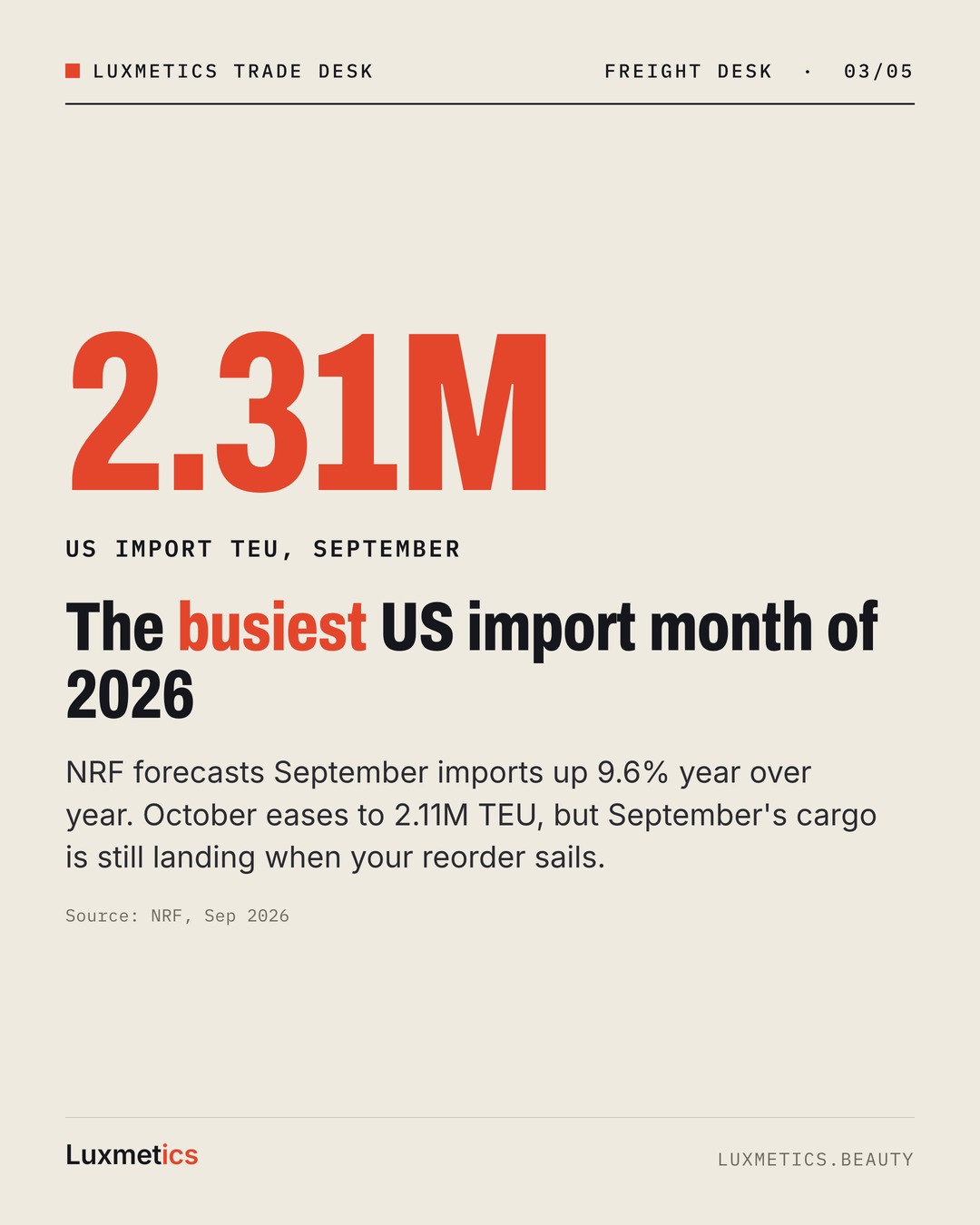
The NRF Global Port Tracker forecasts US imports of 2.31 million TEU in September 2026, up 9.6% year over year and the busiest month of 2026. October is forecast at 2.11 million TEU, November at 2.0 million and December at 2.03 million. NRF also points to rising fuel prices tied to the conflict in Iran.
So the volume peak is behind us on paper, but cargo that left Asia in September is still arriving through October. A spa reorder that leaves Busan in early October joins that tail.
What freight costs right now
Rates are high but no longer climbing fast. Drewry’s World Container Index for September 24 put Shanghai to Los Angeles at $7,838 per 40-foot container, up 2% on the week, and Shanghai to New York at $10,373. The global composite was $4,468, down 1% year over year, and Drewry expected declines the following week with 15 blank sailings around Golden Week.
Those are Shanghai benchmarks, so read them as a direction for the Pacific lanes, and ask your forwarder for a Busan quote. Most spas do not book a full container anyway. What reaches you is the rate your forwarder passes through on a consolidated shipment, and right now that trend is flat to slightly softer.
Air is the fallback, and it is expensive this season. The Baltic Air Freight Index was up 20.9% year over year to September 21, and jet fuel was up 116.5% year over year. Air can make sense for a small top-up of a best seller that is about to run out. For a full retail reorder, it usually eats the margin.
Five steps for an October reorder
This is how we would work an October reorder if we were sitting at your desk this week.

- Count backwards from the shelf date. Pick the day the product must be on your retail wall or in the treatment room. Subtract warehouse receipt, US drayage, ocean transit and the port queue. Then add the Korean holidays still ahead: Gaecheonjeol falls on Saturday, October 3, with a substitute holiday on Monday, October 5, and Hangeul Day is Friday, October 9. That is two more lost weekdays on the Korean side.
- Carry the queue you can see. If Busan waits sit at 2–3 days in week 40, put that into your date math. Hoping it clears is not a plan.
- Split urgent from routine. Put the two or three SKUs that sell out first on the earliest sailing, or on air if the margin holds. Let slower items ride the next consolidation.
- Ask for a ready date in writing. A production-complete date given after Chuseok is worth more than a lead time quoted before it. Ask whether your goods were packed before the break or are waiting for the line to restart.
- Protect the back bar first. If a product is used in services, running out cancels appointments. Retail can run thin for a week. Your treatment protocols cannot.
None of this needs new software. It needs a calendar, the numbers above and one direct conversation with your supplier about what shipped before the holiday and what did not.
A short note on the rest of the quarter: October is forecast to be lighter than September at US ports, and ocean rates were already easing at the composite level. If your reorder is not urgent, a sailing in the second half of October may land into a calmer port than one booked this week. If it is urgent, book now and accept the queue.
Planning an October reorder with us
Our team works in Seoul and LA, so we see both ends of this lane in the same week. For an October reorder, we confirm post-Chuseok ready dates directly with Korean suppliers, consolidate several brands into one shipment so a small spa order does not wait alone for space, check labels and MoCRA product listings before cartons leave Korea, and brief your team on anything new that lands on the shelf. You decide what is urgent. We keep the dates honest and tell you early when one moves.
Port waits and freight rates change week to week. Use these figures as a late-September snapshot and confirm current transit times and costs with your forwarder.