

In the September warehouse photographs, a master carton of Centellian24 ampoule pads stands next to a carton of Laneige lip masks, and a stack of Biodance sheet-mask boxes waits behind them for the same stretch wrap. Dongkook Pharmaceutical, Amorepacific and Biodance have no arrangement with one another. Their factories are in different places, their sales teams have never shared a meeting, and none of the three knows the other two are in this order. The only reason their cartons are in one frame is that a US buyer placed one order and a Korean sourcing desk turned three separate supply relationships into a single consolidated shipment.
Consolidation is easy to describe and easy to oversell. What follows is the mechanics of what actually changes for the buyer when three brands leave Korea as one order, and the one thing that does not change at all.
One exporter of record instead of three
Bought separately, three brands mean three sellers, and three sellers mean three commercial invoices, three packing lists, three sets of ingredient documentation and three parties whose paperwork has to agree with itself and with the customs entry. Each brand invoices in its own format, codes its products in its own way and answers broker questions on its own schedule.
When the order is consolidated, the sourcing desk buys from the three brands and sells to the buyer, so it becomes the single exporter of record. The buyer receives one commercial invoice set with sixteen lines on it, one packing list that maps those lines to cartons, and one point of contact when the broker asks why a line reads 20 g while the carton label reads 0.70 oz. Classification still happens line by line, because a broker classifies products rather than shipments, but the document that carries the classification is one document, signed by one party. The buyer’s own broker still files the entry; what changes is how many exporters’ paperwork that broker has to reconcile before filing it.

One consolidated shipment, one booking, one count
Freight follows the paperwork. Three separate orders are three bookings, three pickup windows and three deliveries, each arriving on its own day with its own intake. A consolidated shipment is one booking; the cartons are gathered into one pallet build at the Korean warehouse, wrapped, labeled and moved as one unit, which is the pallet described in our earlier post on what a pallet tells you. On the US side the receiving team books one appointment and counts one delivery against one packing list.
Landed cost changes shape as well. Duty is still assessed per line, and the tariffs post covers how those rates fall on Korean cosmetics. What consolidation changes is the denominator: freight, handling and brokerage that would have been paid three times are paid once and spread across every unit in the order. We are not quoting figures here because they depend on the mix, the mode and the month, and any number printed in a blog post would be wrong by the time you read it.
The order moves at the pace of the slowest brand
The trade-off is structural rather than a matter of service. Consolidation does not merge the three brands’ operations. Each brand keeps its own minimum order quantity, its own production calendar and its own release rules. One brand may ship from finished stock within days of an order; another may produce to order and release when its batch is done; a third may hold export packs for a monthly consolidation of its own. The pallet cannot leave until the last carton is on the floor.
So a buyer who consolidates is accepting the slowest brand’s calendar for the whole order. There are three honest responses. Accept the date and plan the launch around it. Split the order into two shipments and give up part of the consolidation benefit for the fast brands. Or reshape the SKU mix at the planning stage so that every brand in the order is one that can ship from stock this cycle. The third option is the one a sourcing desk can see and a buyer usually cannot, because it depends on knowing which brand is sitting on inventory this month, and that knowledge lives in the warehouse rather than on a line sheet.
The cartons are the evidence
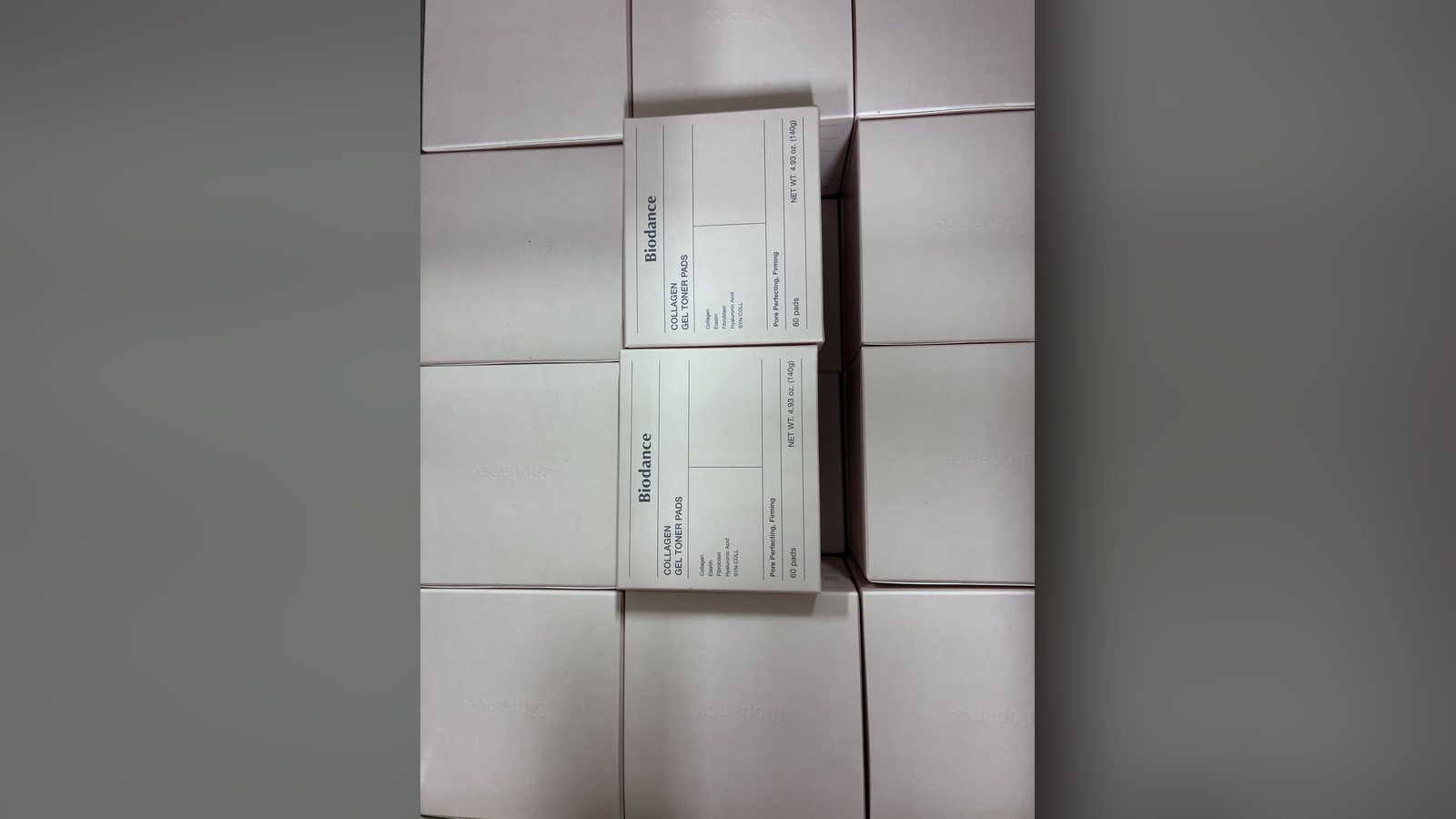
The proof that consolidation happened is not a document. It is the warehouse floor: master cartons of each of the sixteen SKUs, packed in unit boxes, photographed together before the wrap goes on. The Centellian24 cartons follow Dongkook’s carton conventions; the Laneige cartons hold two different pack routes for the same lip mask, the English-only EX packs and the EN/FR bilingual North American packs; the Biodance cartons hold the pale grey Real Deep Mask boxes. Three brands’ carton logic in one frame is what a mixed order looks like before anyone tidies it into a single packing list. A photograph of a wrapped pallet proves that something left the warehouse; the unwrapped cartons prove what it was.
Ask for those photographs before payment, and read them the way the broker will read the invoice: one SKU per carton label, lot and expiry visible, unit count per carton legible. A consolidated shipment unifies the paperwork for customs. For the intake team it is still three brands with three ways of labeling a box, and the photographs are the only way to know that before the truck arrives.
What the desk in Seoul holds on a mixed order
Luxmetics holds the three brand relationships, buys against each brand’s own minimum and calendar, issues the single commercial invoice and packing list as exporter of record, books the freight, and reviews the label and lane of every SKU before the pallet is wrapped. The buyer sees one order. The desk sees three, and its job is to make sure the buyer never has to.