
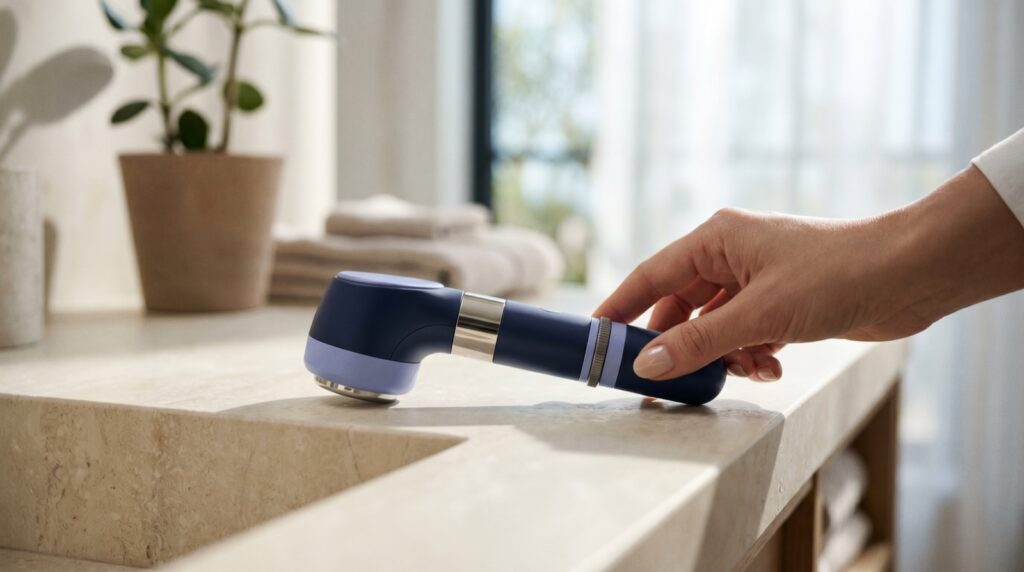
Korean aesthetic devices have become the quiet hardware engine behind the global beauty boom. The serums and sheet masks get the attention, but the radiofrequency, ultrasound, microcurrent, and LED platforms coming out of Korea are now reshaping how American med-spas and clinics deliver results — and how they price them. For any U.S. operator deciding what to put in a treatment room this year, the shift is impossible to ignore.
The numbers behind Korea’s device surge
Korea’s energy-based device makers are no longer regional players. Classys, the country’s leading manufacturer, reported 2025 consolidated revenue of 336.8 billion won — up 38.6% year over year — at an operating margin north of 50%. More than 70% of that revenue now comes from outside Korea, with over 45,000 platforms installed across more than 80 countries and roughly 5.5 million HIFU procedures performed on its systems in 2025 alone. Its closest rival, Wontech, grew revenue 36.1% over the same period.
That momentum is pointed squarely at the West, where equipment and consumables command higher price points than in Asia. Korea now exports well over $1.6 billion in cosmetic devices a year, and named platforms — Classys’s Volnewmer (marketed in the U.S. as Everesse), Jeisys’s DENSITY, Viol’s Scarlet RF microneedling system — are entering American clinics directly.
The market they’re entering is expanding on its own. The global energy-based aesthetic device market sat at roughly $8.4 billion in 2025 and is projected to reach $16.5 billion by 2030, a 14.4% compound annual growth rate, according to Mordor Intelligence. North America already holds the largest share. On the demand side, AmSpa counted 10,488 U.S. med-spas in 2023 — up from 8,899 a year earlier — with the count forecast to keep climbing past 11,500. More rooms means more devices.
Four modalities U.S. clinics are adding
Not every category is moving at the same speed. Four stand out for operators evaluating Korean-made equipment:
- Radiofrequency (RF) and RF microneedling. The fastest-growing category for skin tightening and texture. Fractional RF systems that pair heat with microneedling are the workhorses of modern facial treatment menus.
- Microcurrent. Low-downtime “lunchtime” lifting that rebooks well and pairs naturally with facials. Korean professional units compete hard on price against legacy Western brands.
- LED / photobiomodulation. Inexpensive to run, easy to delegate, and an effective add-on that lifts ticket size without adding clinical risk.
- Scalp-care devices. The newest frontier, riding the head-spa wave — analysis cameras, RF, and LED tools built specifically for the scalp rather than the face.
FDA clearance is the non-negotiable
Here is where sourcing gets serious. In the United States, most facial RF systems, microcurrent stimulators, and LED devices are regulated as Class II (moderate-risk) medical devices under 21 CFR Part 878, cleared through the FDA’s 510(k) pathway by demonstrating “substantial equivalence” to a legally marketed predicate device. A device sold legally in Korea is not automatically cleared for professional use in the U.S.
For a clinic, the practical rule is simple: if a Korean device cannot show a valid 510(k) clearance and real clinical evidence — before-and-after data, not brochure copy — it does not belong in your treatment room. The FDA has already issued safety communications on the risks of certain RF microneedling uses, and importing non-cleared equipment exposes an operator to both regulatory and liability risk.
What to look for when sourcing
Beyond clearance, experienced buyers screen Korean devices on four practical criteria:
- Consumable economics. Cartridges and tips drive the real cost of ownership. A device with a cheap sticker price and expensive disposables can quietly erode margin treatment by treatment.
- Versatility and throughput. Multi-modality platforms with low downtime let a single room serve more indications and more clients per day.
- A verified supply chain. The popularity of Korean devices has produced a gray market of knock-offs and unauthorized resellers. Buying through a verified channel protects warranty, training, and parts.
- Training and protocols. A device is only as good as the technician running it. Manufacturer-backed training turns a capital purchase into billable revenue faster.
For context on pricing, single-modality systems typically land between $35,000 and $60,000, while legacy multi-platform devices run $80,000 to $150,000 and up — which is exactly why competitively priced, FDA-cleared Korean equipment is winning room in the budget.
The operator’s view
Korean device makers have spent a decade building the clinical credibility and manufacturing scale to compete anywhere. The opportunity for U.S. clinics is real, but it runs through clearance, verification, and training — not just a lower invoice. At Luxmetics, we source Korean-made RF, microcurrent, LED, and scalp-care devices directly from the manufacturer, verify FDA status before anything ships, and include technical training and import support so a new device starts earning instead of sitting idle. If you are planning your 2026 equipment roadmap, that is the bridge we build.
Weighing a Korean device for your treatment room? Luxmetics places professional devices from our manufacturing partner WSD, with install, staff training, and an ongoing consumables supply line. See how our device sourcing works.