

Ask a US med spa owner where the backbar comes from and you will usually hear the name of a distributor. Ask the same question about a Korean professional line and the answer often points to a clinic. The two countries move professional skincare to the treatment room along different routes, and a US buyer who understands both can build a stronger shelf than either route offers alone.
The US professional channel, by the numbers
The US professional market is large, fragmented and licensed state by state. The American Med Spa Association (AmSpa) puts med spa industry revenue above $17B and growing by more than $1B a year. Its 2024 data counted about 10,488 locations with average revenue of $1.40M per med spa. Those are 2024 figures, and location counts for 2026 vary by source, so treat them as a floor for scale rather than a current census.
The people doing the work are counted separately. The US Bureau of Labor Statistics reports 104,200 skincare specialist jobs in 2025, with employment projected to grow 9% from 2025 to 2035. Licensing is set by each state, which means scope of practice, and therefore which products and services a team can use, changes at every state line.
Median pay for those specialists was $45,330 in 2025. That figure matters to an owner adding a new line, because every new product needs someone on the team who can explain it well, and training time is paid time. A line that arrives without education costs more than its invoice.
Supply runs largely through distributors. SalonCentric, owned by L’Oréal, operates 600+ US beauty supply stores and opened an Anchorage location in May 2026. CosmoProf, part of Sally Beauty, is the other national professional distributor. For an esthetician or salon, these stores are where many professional brands are bought, compared and reordered.
The model has clear strengths. A distributor offers breadth, fast reorders and credit terms. The trade-off is distance: the brand often sits two steps away from the person performing the service, and product education competes with everything else on the distributor’s shelf.
The Korean route: close to the clinic
In Korea, many professional lines are tied to dermatology and skin clinics, where products are used in treatment and sold to the same client afterward. The line and the service travel together. Ingredients that build a following in clinics can later cross into consumer retail.
PDRN is the current example. REJURAN Cosmetics, a PDRN skincare line, is one of 19 brands in the OLIVE YOUNG K-beauty Edit that Sephora rolled out to 500+ US stores and Sephora.com from August 20, 2026, according to the Sephora Newsroom. An ingredient known from Korean clinics now sits on a US retail shelf.
The clinic route also shapes how brands teach. When a line is sold through the place that performs the treatment, the product and the protocol tend to be designed together. For a US buyer, that protocol is often as valuable as the product: it tells the team what to use, in what order, and what to recommend at the end of the service.
US shoppers are already primed for that kind of crossover. In the first quarter of 2026, clinical brands took over one-third of US prestige skincare dollars, according to Circana. Clients increasingly expect the products at their spa to feel as considered as the treatment itself.
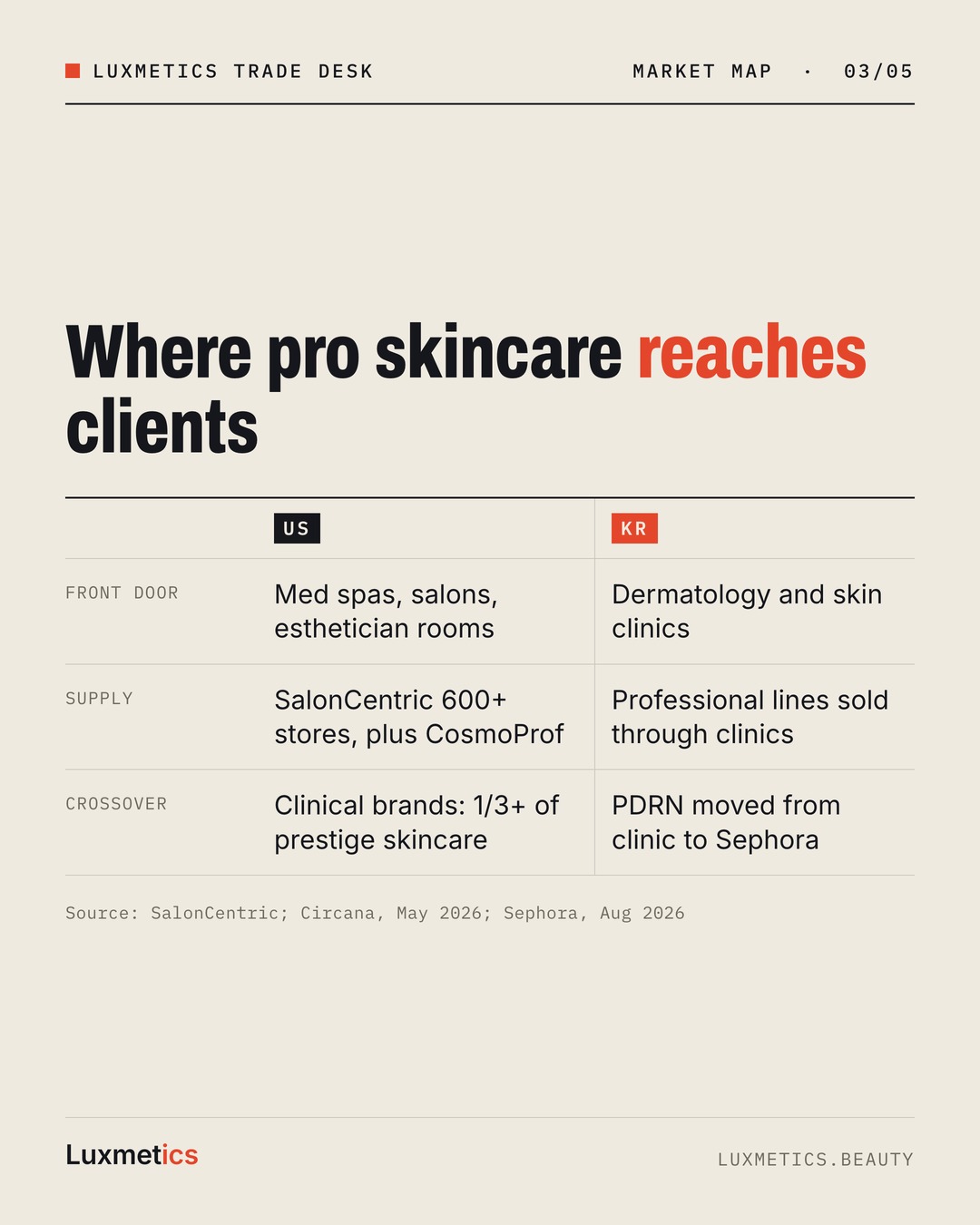
What a US spa can borrow from each side
Neither route is better in every case. The useful question is which parts of each fit your business.
- Keep the distributor for staples. Cleansers, basics and high-turn items benefit from fast reorders and local stock.
- Borrow the clinic model for signature lines. For the products tied to your best services, a direct line to the brand gives better training, clearer protocols and a retail story your team can tell.
- Match the product to the license. A professional product is only useful if your team’s state scope allows the service it supports. Check scope before you commit to a line.
- Price retail after the service. The Korean model sells the product at the moment the client has just felt the result. Put the take-home recommendation in the protocol, not at checkout as an afterthought.
A mixed model costs some effort. Direct lines need their own ordering, labels and paperwork. For a spa that already runs a distributor account, one or two direct signature lines is usually enough to create a point of difference without adding too much work.
The simplest test is to look at your top five services by revenue and ask which product each one ends with. If the answer is a product a client can find in any aisle, that service has room for a signature line.
The distributor steps, handled
Luxmetics sources Korean professional lines for US med spas, clinics and salons, and we handle the steps a distributor usually covers: checking US labels and MoCRA product listings, consolidating several brands into one shipment, and training your team on the protocols each line was built for. You decide which services deserve a signature line. We help you bring the Korean clinic model into a US room, inside your state’s rules.