
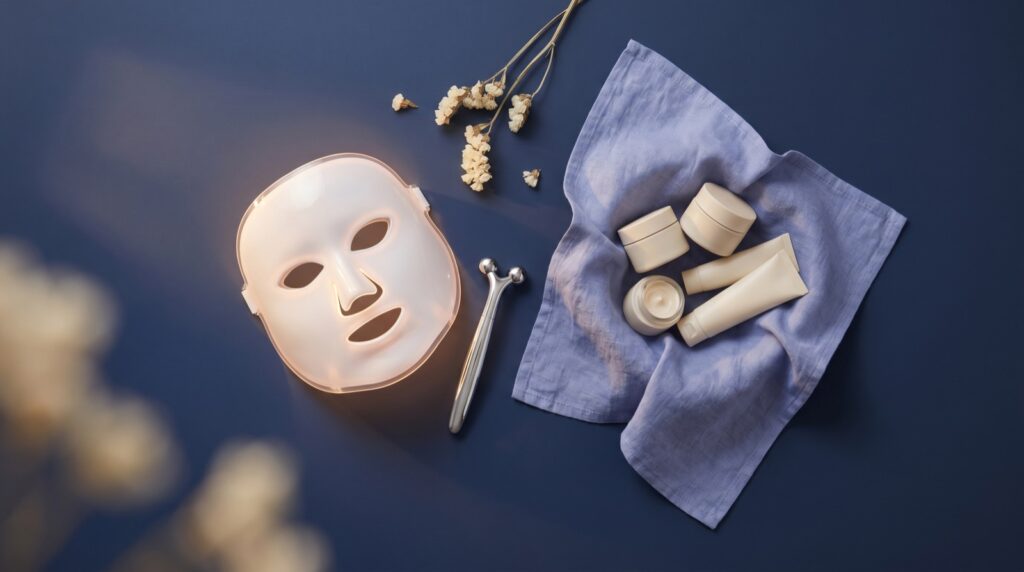
For a decade the line was simple: light therapy, microcurrent, and radiofrequency lived in the clinic, and the clinic charged for the privilege. That line is dissolving. At-home beauty devices — LED masks, microcurrent toning tools, RF wands — are no longer novelty gadgets. They are being absorbed into daily routines as partial replacements for scheduled in-clinic care, and the numbers behind that shift are getting hard to ignore.
This matters to anyone sourcing or distributing beauty hardware, because the center of gravity is moving. The question is no longer “will consumers buy a device?” It is “what does professional-grade mean when the consumer already owns the device?”
The market is repricing in-clinic care
The at-home therapeutic beauty device market is projected to grow from USD 5.5 billion in 2025 to USD 12.4 billion by 2035, an 8.5% CAGR (Future Market Insights). Broader “beauty device” tallies that fold in professional equipment run larger and faster still, but the home-use therapeutic segment is the one reshaping consumer behavior.
Within that segment, the modalities pulling demand are exactly the ones that used to require an appointment. Photorejuvenation and LED-therapy devices are forecast to be the fastest-growing category from 2026 through 2032, on the back of accumulating clinical data for photobiomodulation and rising consumer awareness (PS Market Research). In anti-aging devices specifically, LED and RF technologies together hold roughly 72% of the market — a concentration that tells you where the spend is going.
The driver is arithmetic. A course of in-clinic LED or microcurrent facials runs into hundreds of dollars per month. A capable home device is a one-time purchase in the same range. For a consumer who has already felt the result in a clinic, the home unit is not a downgrade — it is the maintenance plan.
“Pro-grade” now has FDA-cleared meaning
The credibility gap that used to protect clinics is closing because the better home devices carry the same regulatory language clinics use. Consumer LED masks from CurrentBody and Omnilux are FDA-cleared; CurrentBody launched its Series 2 mask in September 2024, and the Omnilux Contour uses 132 medical-grade LEDs at the well-studied 633nm and 830nm wavelengths, with the platform citing over 40 peer-reviewed clinical studies. On the microcurrent side, NuFACE is FDA-cleared for facial muscle stimulation — the “workout for the face” framing that consumers now repeat back to staff.
For an operator, that is the headline: the home category is no longer competing on price alone. It is competing on the same clearances, wavelengths, and study counts that a treatment room would put on its menu. A device that can claim a clearance and a wavelength spec is a different commercial object than a gadget that claims a “glow.”
Where Korea sits in this
Korea is one of the strongest home beauty-tech ecosystems in the world, and it shows up in this exact crossover. Korean brands built the consumer LED-mask and home-device categories early — Cellreturn’s LED masks, Medicube’s AGE-R line, and LG’s Pra.L devices among them — and Korean manufacturers supply a large share of the world’s home device hardware on an ODM basis. For a US or India buyer, that means the supply for this trend is concentrated in exactly the manufacturing base Luxmetics works in daily.
It also means the usual caution applies. “Device” is a regulated word. A home cosmetic device that makes treatment claims, emits energy, or is marketed for a medical effect can cross into FDA device territory, and clearance status is not interchangeable between markets. Sourcing the hardware is the easy part; sourcing it with the documentation that lets you sell the claim is the work.
The operator’s view
The reflex among professionals is to treat home devices as a threat. The sharper read is that they are a funnel. A consumer who buys a $400 LED mask has self-identified as someone who will pay for results — and home devices plateau where professional ones do not. The clinics and salons winning this cycle are the ones selling the device, the protocol, and the in-room treatment as one ladder, not pretending the bottom rung does not exist.
Three moves follow from the data:
- Retail the category you compete with. Stocking a clinically credible home device turns a perceived competitor into attach revenue and a reason for the client to come back for the pro tier.
- Source on documentation, not just spec. The price of Korean home-device hardware is attractive; the value is in the clearance, wavelength data, and labeling that let you make a defensible claim. Buy the paperwork with the product.
- Position the room as the ceiling. Home LED maintains; professional RF and stacked modalities deliver outcomes a mask cannot. Make the difference explicit on the menu instead of hoping clients infer it.
How Luxmetics fits here is narrow and practical: we source home and professional beauty-tech from the Korean manufacturing base, verify the regulatory documentation that makes a device sellable in your market, and help operators build the device-to-treatment ladder rather than get flattened by it. The crossover is not a threat to sourcing partners. It is the whole point of having one.