
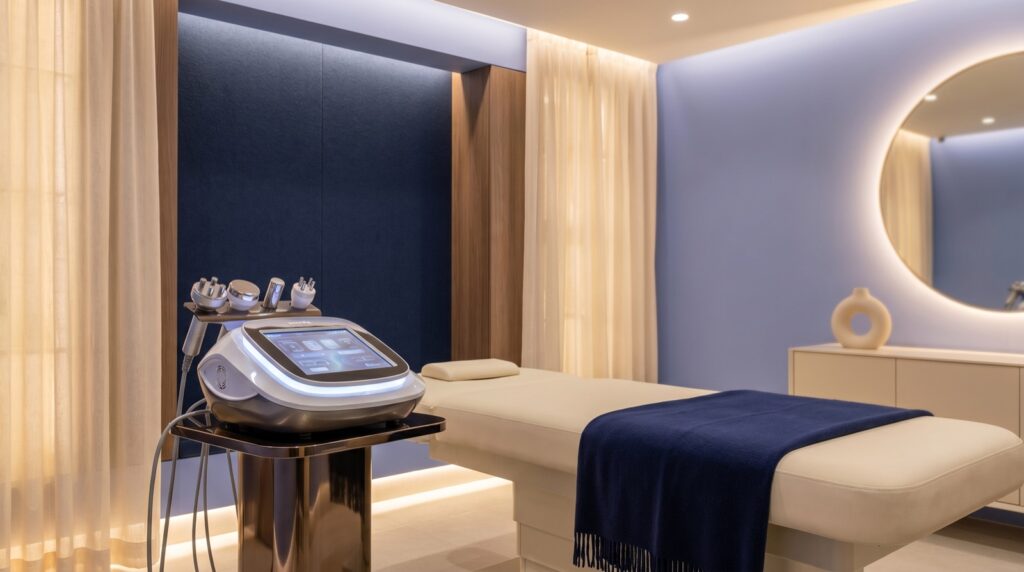
This is a representative case study. To protect client confidentiality, the scenario below is an illustrative composite built from current industry benchmarks rather than a single named client. The figures are real market ranges; the story is a model of how adding a Korean RF device to a med-spa typically pencils out.
A busy US med-spa wants to add radiofrequency microneedling — the category driving skin-tightening demand — and is weighing a Korean device against pricier Western platforms. The owner’s question is the right one: not “which machine,” but “how fast does it pay for itself, and what does it take to run it legally and well?” This model walks through the answer.
The challenge
The opportunity is real: the average US med-spa now sees about 245 patient visits a month at an average spend of $527 per visit, with a 73% repeat rate (AmSpa, 2024). But a device only earns when it’s booked and staffed. The two ways these launches fail are buying capacity nobody is trained to run, and — less obvious — running afoul of state scope-of-practice rules on who may operate the device at all.
The approach: the right device, certified staff, compliant scope
The model is built around three decisions:
- Device. A Korean RF-microneedling system. Entry FDA-cleared units start around $30,000, well below multi-platform Western systems at $50,000–$200,000+. Named Korean RF devices now in the US market include Lutronic’s Genius, Jeisys’s DENSITY, and Classys’s Volnewmer (sold as Everesse) — with Cartessa and Classys launching QUADESSY in the US in March 2026.
- Certification. Manufacturer training comes with installation; third-party hands-on energy-device certification runs about 1–2 days (roughly $1,500–$1,700 per technician). The point is competency before the first paid treatment, not after.
- Scope-of-practice — the trap. Certification documents training but does not override state law. California prohibits estheticians from microneedling; Washington and Utah restrict it to master estheticians; Florida permits licensed estheticians. Confirming who can legally run the device in your state is step one, not an afterthought.
The illustrative payback math
RF-microneedling sessions commonly price at $500–$1,200, often sold as a series of three. Take a conservative net of about $650 per treatment at six treatments a week: that’s roughly $16,900 a month in gross treatment revenue, before staff, room, and disposable-tip costs. Against a ~$40,000 device, that tracks to the industry’s documented 3-to-9-month payback range for well-utilized aesthetic devices (Crestmont Capital; clinic menu pricing).
A necessary caveat: these payback figures come largely from device-financing guides and clinic menus and assume strong utilization — they’re modeled, not guaranteed. The lever isn’t the discount on the machine; it’s hitting the booking volume.
Stretching utilization with recurring revenue
The model adds two margin levers. First, RF, microcurrent, and LED are largely low- or zero-consumable compared with fractional laser, so more of each ticket is margin (RF microneedling still carries a per-session sterile-tip cost). Second, a membership — commonly $50–$300 a month, bundling a monthly treatment or credit plus member pricing — smooths utilization and pulls the payback curve forward by keeping the device booked.
The illustrative outcome
Defined against benchmarks rather than a fabricated number: a single Korean RF device, sourced at a fraction of a Western platform’s cost, staffed by certified technicians operating within state scope, priced into the documented $500–$1,200 band, and supported by a membership — tracking toward the 3-to-9-month payback that well-run device programs achieve. The hardware was the easy part; the certification, scope compliance, and booking plan are what made it pay.
How Luxmetics works on devices and education
We supply Korean-made RF, microcurrent, LED, and scalp devices with technical training and import support included, verify each device’s FDA status before it ships, and run the certification and protocol programs that get staff to competency fast. We also flag the state scope-of-practice realities before you buy, not after. If you’re adding a Korean device to your med-spa in 2026, we make sure it earns from the first month — legally and profitably.
Planning your own device payback? Luxmetics places professional devices from our manufacturing partner WSD, with install, staff training, and an ongoing consumables supply line. See how our device sourcing works.