
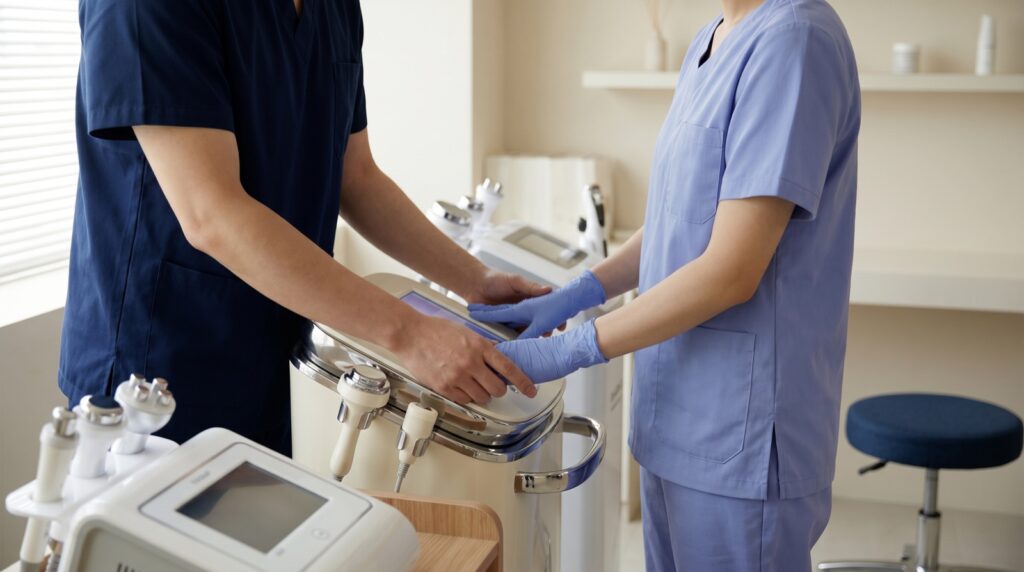
This is a representative case study. To protect client confidentiality, the scenario below is an illustrative composite built from current industry benchmarks rather than a single named client. The figures are real market ranges; the story is a model of how an aesthetic device rollout and certification program typically works.
A multi-room clinic wants to modernize its treatment menu with Korean RF, microcurrent, LED, and scalp devices. The owner has the capital and the demand — but has watched competitors buy expensive machines that end up gathering dust because no one was trained to run them or booked to fill them. The fear is rational, and it is the exact failure mode this model is built to avoid.
The challenge
Device economics are unforgiving in one specific way: utilization is everything. A basic device-led med-spa build can run $150,000–$250,000 in capital, and the single biggest killer of return is an idle machine. Manufacturers model fast payback only at sustained volume — typically 10–20 sessions per week per device at high uptime. Buy the hardware without solving for trained staff and booked chairs, and the math never works.
The approach: phased rollout plus certification
The model treats training and booking as part of the purchase, not an afterthought:
- Phase the buy. Start with high-utilization, lower-risk modalities — an RF microneedling unit (entry FDA-cleared systems run roughly $3,000–$4,000), a professional microcurrent platform (packages from around $7,500), and LED and scalp-analysis devices — rather than buying everything at once.
- Certify the staff. Run a structured program of one-to-two-day hands-on certification per modality, layered on existing state licensure, so technicians reach competency before the device goes live. Scope-of-practice and medical-oversight rules are confirmed up front, since medical-grade devices require it in many states.
- Sell in packages. Move treatments through packages and memberships rather than single sessions — an approach that industry data suggests recovers device investment roughly 30% faster.
- Target the payback threshold. Build the booking plan around the 10–20 sessions-per-week, high-uptime benchmark that makes the device economics work.
The illustrative outcome
Pricing is anchored to documented bands: microcurrent facials in the $250–$500 range, RF microneedling in the $500–$1,500 range, with consumables of roughly $8–$25 per treatment area. Against those numbers, manufacturer-modeled payback typically lands in a 6–24 month window depending entirely on utilization — which is why the certification and booking plan, not the discount on the machine, is what determines the return. Well-run device programs also lift rebooking toward the top-tier benchmark of nearly 70% of clients rebooking within 24 hours.
A necessary caveat: these payback and ROI ranges come largely from device manufacturers and represent well-run-clinic economics, not guarantees. We present them as modeled, utilization-dependent figures — which is exactly why the operating plan matters more than the spec sheet.
Why training is the real product
The throughline across the model is that a device is only as valuable as the team running it and the calendar filling it. Korean manufacturers build excellent, competitively priced hardware — but hardware alone is a depreciating asset. The program turns it into a revenue line by closing the competency gap fast and engineering demand from day one.
How Luxmetics works on devices and education
We supply Korean-made RF, microcurrent, LED, and scalp-care devices with technical training and import support included, and we run certification programs and master classes in facials, scalp therapy, and device protocols. We source the right equipment, verify its FDA status, train your team, and help build the booking and packaging plan that makes it pay. If you are modernizing a clinic in 2026, we make sure the devices earn from the first week, not the first year.