
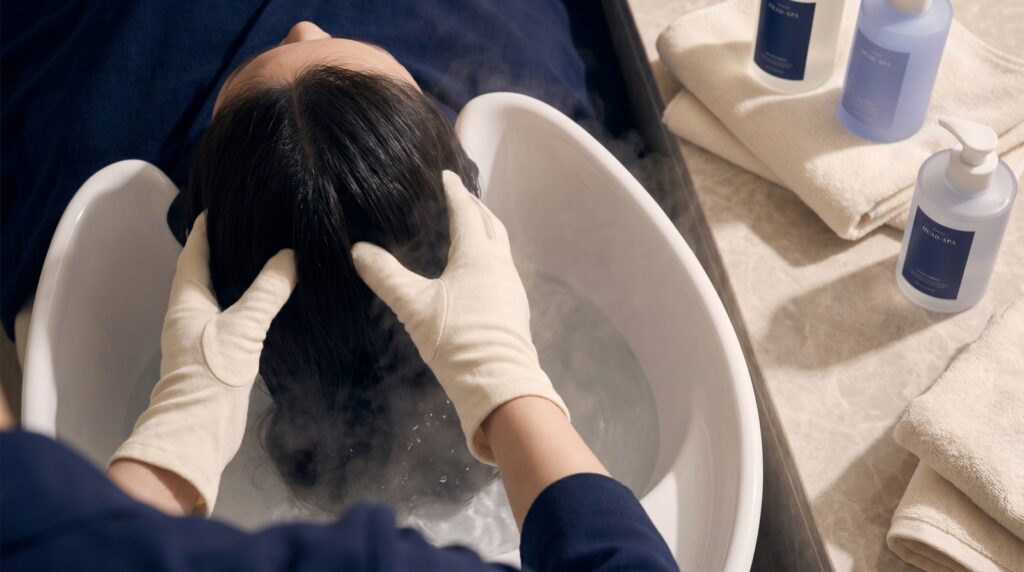
A head spa was, until recently, something you flew to Seoul or Tokyo to experience. Today it is one of the fastest-growing services in American beauty — and one of the clearest business opportunities in the industry. Industry reports put the jump in head-spa-related searches heading into 2025 at well over 200% year on year, and the category has crossed from a niche import into mainstream demand. For salon and spa operators, the question is no longer whether to pay attention, but how quickly to act.
From viral moment to treatment menu
The tipping point is easy to date. In August 2023, a Los Angeles head-spa video crossed 12 million views on TikTok, and the category’s audience changed overnight. One widely cited operator saw its clientele flip from roughly 70% Asian and 30% non-Asian to predominantly non-Asian after going viral — the signal that head spa had broken into the broad U.S. market. Dedicated studios and salon suites have been opening across New York, Los Angeles, Atlanta, and Philadelphia ever since, with multi-location operators now emerging in secondary cities.
The retail data backs the search trend. According to Kline’s professional salon transaction database, scalp-treatment services grew 9% and scalp-care retail products grew 6% in the first three quarters of 2025 versus the prior year. The supply side is moving too: Korean hair-care exports hit a record $478 million in 2025, up 15.7%, as skincare-first brands like COSRX and VT extend into scalp and hair.
What a head spa actually is
For operators new to the category, the service is a structured, multi-step scalp treatment — closer to a facial for the head than a wash. A typical protocol runs:
- Scalp diagnosis using a magnification camera (often 200x) shown live on a screen — the moment that sells the treatment and the products.
- Deep cleanse and exfoliation to clear buildup and prep the scalp.
- Steaming and targeted serums matched to the client’s concern: oil, flaking, sensitivity, or thinning.
- Therapeutic massage of the scalp, neck, and shoulders — the relaxation payoff that drives rebooking.
The business case: a $40 service becomes a $200 treatment
This is where head spa earns its place on a menu. Scalp treatments already command a premium inside salons — averaging just over $40 per service versus roughly $36 for other hair treatments. But dedicated 60-minute head-spa sessions in comparable markets run $150 to $250, with signature services reaching $450. That is a three-to-five-times revenue multiplier over a standard wash-and-style, delivered in the same chair time.
The retention economics are just as compelling. Operators in mature head-spa markets report strong rebooking among clients on monthly or bi-monthly cadences, plus meaningful upticks in treatment-package sales once a scalp scanner is part of the consultation. A relaxation-forward, visibly diagnostic service is built to repeat — the opposite of a one-time splurge.
Why the whitespace is so large
Here is the figure that should focus any operator’s attention: scalp treatments still account for only about 0.1% of total salon services, even as scalp-benefit products have already reached 3.4% of salon retail sales. The product demand is running well ahead of the service supply. Combine that gap with a global wellness economy projected past $7 trillion and a U.S. spa-services market that reached $26 billion in 2026, and head spa looks less like a fad and more like an under-built category with years of runway.
What it takes to launch
Adding a head spa is not as simple as buying a chair. A credible launch needs a plumbed treatment station, a scalp-analysis camera, a defined protocol, trained staff, and — critically — a reliable supply of professional Korean scalp products to retail at the chair. Most U.S. operators can layer the service onto an existing space, but the difference between a profitable head-spa room and an idle one comes down to protocol design, product sourcing, and staff training.
The operator’s view
The head-spa boom is a rare alignment: surging consumer demand, a built-in price premium, high rebooking, and a supply chain — Korea’s — that is purpose-built for it. At Luxmetics, we open head spas turnkey: concept and interior, the right Korean equipment, treatment protocols, staff certification, and the scalp-care product line to sell alongside the service. If you are weighing a head spa for your salon or a standalone studio, we can tell you exactly what it takes to make the room pay for itself.
Thinking about a head spa of your own? Luxmetics opens turnkey head spas with our partner WSD, from design and room layout to sourcing, staff training, and launch. See how our head spa openings work.